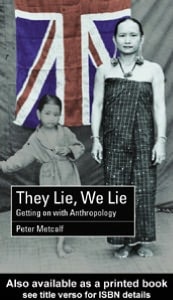
They Lie, We Lie: Getting on with Anthropology
0
0
As an Amazon Associate and affiliate partner, Menrva Books earns from qualifying purchases. Learn more
Author Description
They Lie, We Lie is an attempt by an experienced fieldworker to engage recent critiques in ethnography, that is the writing of culture, made both from within anthropology and from such disciplines as cultural studies and post-colonial theory. This is necessary because there has been a polarization within anthropology between those who react dismissively to what Marshall Sahlins calls 'afterology' and those who find the critiques so crippling as to make it hard to get on with anthropology at all. Metcalf bridges this divide by analyzing the contradictions of fieldwork in connection with a particular 'informant', a formidable old lady who tried for twenty years to control what he would and would not learn. At each stage, the author draws out the general implications of his predicament by making comparisions to the most famous of all fieldwork relationships, that between Victor Turner and Muchona. The result is an account that is accessible to those unfamiliar with the current critiques of ethnography, and helpful to those who are only too familiar to them. His discussion shows, not how to evade the critiques, but how in fact anthropologists have coped with the existential dilemmas of fieldwork.
Menrva's Summary
THE THESIS
This book investigates how anthropologists can reconcile the practice of fieldwork with the intense theoretical critiques emerging from cultural studies and post-colonial theory. Peter Metcalf, an experienced fieldworker, addresses the polarization within the discipline between those who reject these critiques and those who find them paralyzing. By examining his own long-term fieldwork relationship with a challenging informant, Metcalf provides a practical framework for navigating the inherent contradictions and existential dilemmas of ethnographic research.
THE SCOPE MAP
What You Will Find
- Analysis of the power dynamics and contradictions inherent in fieldwork relationships.
- A comparative study of the author's personal experiences alongside the famous Victor Turner and Muchona case.
- An evaluation of the impact of post-colonial and cultural studies critiques on the writing of culture.
- Practical strategies for maintaining ethnographic integrity while acknowledging the limitations of the field.
THE AUTHORITY PERSPECTIVE
Experts and students of anthropology frequently cite this work as a balanced, accessible bridge between abstract theoretical debates and the realities of field research. It is widely regarded as a helpful resource for those seeking to understand how practitioners navigate the complexities of ethnographic representation.
Page Count:
168
Publication Date:
2003-01-01
Publisher:
Taylor & Francis Group
ISBN-10:
0203116690
ISBN-13:
9780203116692
Non-Fiction
Anthropology
Ethnography
Malaysia
Social Science
Community Tags
Similar Books