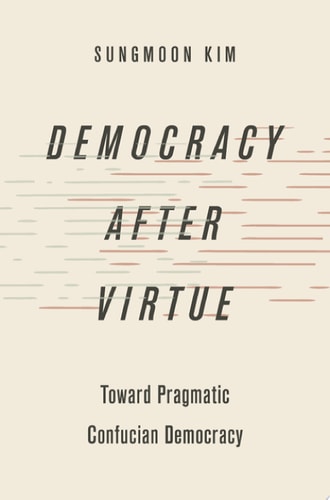
Democracy after Virtue: Toward Pragmatic Confucian Democracy
0
0
As an Amazon Associate and affiliate partner, Menrva Books earns from qualifying purchases. Learn more
Author Description
Is Confucianism compatible with democracy? Ongoing debates among political theorists revolve around the question of whether the overarching goal of Confucianism -- serving the people's moral and material well-being -- is attainable in modern day politics without broad democratic participation and without relying on a "one person, one vote" system. One side of the debate -- voiced by "traditional" Confucian meritocrats -- argues that only certain people are equipped with the moral character needed to lead and ensure broad public well-being. They emphasize moral virtue over civic virtue and the family over the state as the quintessential public institution. Moreover, they believe that a system of rule headed by meritorious elites can better handle complex modern public affairs than representative democracy. The other side -- voiced by Confucian democrats -- argues that unless all citizens participate equally in the public sphere, the kind of moral growth Confucianism emphasizes cannot be fully attained. Despite notable differences in political orientation, scholars of both positions acknowledge that democracy is largely of instrumental value for realizing Confucian moral ends in modern society. It would seem that Confucians of both types have largely dismissed democracy as a political system that can mediate clashing values and political views -- or even that Confucian democracy is a system marked by pluralism. In this book, Sungmoon Kim lays out a normative theory of Confucian democracy -- pragmatic Confucian democracy -- to address questions of the right to political participation, instrumental and intrinsic values of democracy, democratic procedure and substance, punishment and criminal justice, social and economic justice, and humanitarian intervention. As such, this project is not only relevant to the much debated topic of Confucian democracy as a cultural alternative to Western-style liberal democracy in East Asia, but it further investigates the philosophical i
Menrva's Summary
THE THESIS
This book investigates whether Confucianism can be reconciled with modern democratic systems through the development of a normative framework termed pragmatic Confucian democracy. Sungmoon Kim, a scholar of political theory, evaluates the tension between Confucian meritocratic traditions and the requirements of modern democratic participation. By synthesizing these disparate political philosophies, the author argues for a model that treats democracy as both an instrumental and intrinsic necessity for achieving Confucian moral objectives in contemporary society.
THE SCOPE MAP
What You Will Find
- A normative theory of pragmatic Confucian democracy
- Analysis of political participation rights and democratic procedures
- Examination of social justice, criminal justice, and humanitarian intervention within a Confucian context
- Comparative critique of Western liberal democracy versus East Asian political alternatives
Scope Limits
- The text does not provide a comprehensive historical survey of all Confucian political movements
- It does not offer a practical policy manual for current government implementation
THE AUTHORITY PERSPECTIVE
Scholars and political theorists frequently cite this work as a significant contribution to the discourse on non-Western democratic models. Readers often note the academic density of the prose, which requires a foundational understanding of both Confucian ethics and contemporary political theory to fully grasp the author's arguments.
Page Count:
272
Publication Date:
2018-01-01
Publisher:
Oxford University Press
ISBN-10:
0190671254
ISBN-13:
9780190671259
Political Philosophy
Asian Studies
Comparative Politics
Democracy
Comparative Government
Confucianism
East Asia
Community Tags
Other Editions(2)
Similar Books

Reader Comments
Share Your Thoughts
No comments yet. Be the first to share your thoughts!