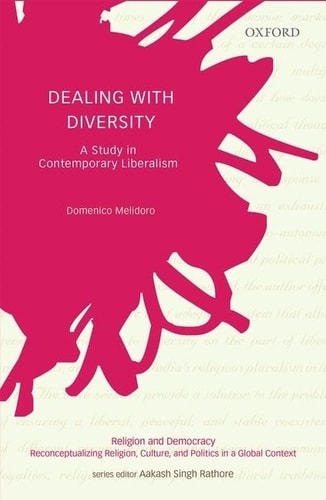
Dealing with Diversity: A Study in Contemporary Liberalism
0
0
As an Amazon Associate and affiliate partner, Menrva Books earns from qualifying purchases. Learn more
Author Description
About the Author Domenico Melidoro, Lecturer at the Department of Political Science, LUISS University of RomeDr. Domenico Melidoro is Lecturer at the Department of Political Science at LUISS University of Rome Product Description Contemporary liberal societies are marked by a certain degree of diversity indicated by coexistence of multiple ideas, doctrines, beliefs and cultural practices. But a complex and differentiated tradition of political thought like liberalism, despite its fundamental reliance on values like autonomy and toleration, adheres minimally to the principle of diversity. The triumphant position of the liberal individual dwarfs the chance of letting diversified existences fit within its boundary. However, in the face of the general depiction of liberalism as an ideology intending to guarantee creation of basic values like peace, pluralism, equality, diversity becomes a fact "that should be faced". Thus, the author in this volume works out an exhaustive theoretical classification of liberalism into comprehensive pro-autonomy, pro-toleration, political pro-autonomy, and political pro-toleration. With a detailed discussion on the different definitions of liberalism, the author conceptualisesa normative framework, for liberalism to deal with the existence of the concept of diversity. The book thus presents a comprehensive account of critical evaluation of these four variants of liberalism with regard to diversity and their ability to deal with diversity in a proper way.
Menrva's Summary
THE THESIS
This volume investigates how contemporary liberal political theory can effectively reconcile its foundational values of autonomy and toleration with the reality of societal diversity. Dr. Domenico Melidoro, a lecturer in political science at LUISS University of Rome, utilizes a rigorous analytical framework to categorize liberalism into four distinct variants: comprehensive pro-autonomy, comprehensive pro-toleration, political pro-autonomy, and political pro-toleration. By evaluating these models, the author constructs a normative structure intended to address the limitations of traditional liberal thought in accommodating pluralistic cultural and belief systems.
THE SCOPE MAP
What You Will Find
- A four-part classification system for liberal political theory.
- A critical evaluation of how autonomy-based versus toleration-based liberalism handles pluralism.
- Theoretical analysis of the intersection between individual rights and collective cultural practices.
Scope Limits
- The text focuses primarily on theoretical and normative political frameworks rather than empirical case studies of specific nations.
- It does not provide a practical policy manual for multicultural governance.
THE AUTHORITY PERSPECTIVE
Scholars in political theory view this work as a structured contribution to the ongoing debate regarding the limits of liberal pluralism. Readers frequently note the academic density of the prose, which is intended for an audience familiar with contemporary political philosophy and democratic theory.
Page Count:
180
Publication Date:
2020-05-26
Publisher:
Oxford University Press
ISBN-10:
0190121130
ISBN-13:
9780190121136
Sociology
Liberalism
Political Philosophy
Democracy
Community Tags
Similar Books