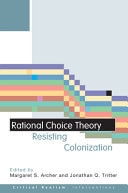
Rational Choice Theory: Resisting Colonisation
0
0
As an Amazon Associate and affiliate partner, Menrva Books earns from qualifying purchases. Learn more
Author Description
Rational Choice Theory Is Flourishing In Sociology And Is Increasingly Influential In Other Disciplines. Contributors To This Volume Are Convinced That It Provides An Inadequate Conceptualization Of All Aspects Of Decision Making: Of The Individuals Who Make The Decisions, Of The Process By Which Decisions Get Made And Of The Context Within Which Decisions Get Made. The Ciritique Focuses On The Four Assumptions Which Are The Bedrock Of Rational Choice: Rationality: The Theory's Definition Of Rationality Is Incomplete, And Cannot Satisfactorily Incorporate Norms And Emotions Individualism: Rational Choice Is Based Upon Atomistic, Individual Decision Makers And Cannot Account For Decisions Made By;couples', 'groups' Or Other Forms Of Collective Action Process: The Assumption Of Fixed, Well-ordered Preferences And 'perfect Information' Makes The Theory Inadequate For Situations Of Change And Uncertainty Aggregation: As Methodological Individualists, Rational Choice Theorists Can Only View Structure And Culture As Aggregates And Cannot Incorporate Structural Or Cultural Influences As Emergent Properties Which Have An Effect Upon Decision Making. The Critique Is Grounded In Discussion Of A Wide Range Of Social Issues, Including Race, Marriage, Health And Education.
Menrva's Summary
THE THESIS
This volume investigates the limitations of Rational Choice Theory by challenging its foundational assumptions regarding human decision-making and social structure. Editors Jonathan Q. Tritter and Margaret S. Archer curate a collection of scholarly critiques that argue the theory fails to account for the complexities of individual agency, emotional influence, and cultural context. By examining the theory's reliance on atomistic individualism and fixed preferences, the authors propose that it remains insufficient for understanding dynamic social processes.
THE SCOPE MAP
What You Will Find
- A critical analysis of the four bedrock assumptions of Rational Choice Theory: rationality, individualism, process, and aggregation.
- Theoretical arguments regarding the role of norms, emotions, and emergent structural properties in decision-making.
- Case studies and discussions applied to diverse social domains including race, marriage, health, and education.
- A methodological critique of how structural and cultural influences are ignored by methodological individualists.
THE AUTHORITY PERSPECTIVE
Experts recognize this text as a significant contribution to the sociological debate surrounding the explanatory power of Rational Choice Theory. Readers frequently note the academic density of the prose, which serves as a rigorous counter-argument for students and scholars of social theory.
Page Count:
272
Publication Date:
2013-01-01
Publisher:
Taylor & Francis Group
ISBN-10:
0203133897
ISBN-13:
9780203133897
Philosophy
Sociology
Social Theory
Academic
Community Tags
Similar Books