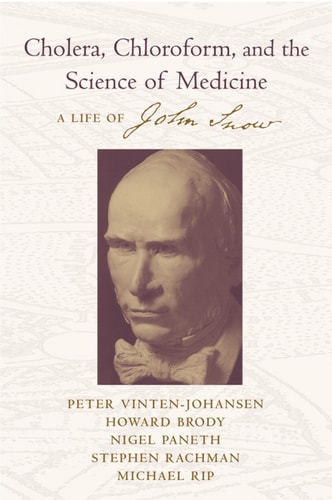
Cholera, Chloroform, and the Science of Medicine: A Life of John Snow
0
0
As an Amazon Associate and affiliate partner, Menrva Books earns from qualifying purchases. Learn more
Author Description
The product of six years of collaborative research, this fine biography offers new interpretations of a pioneering figure in anesthesiology, epidemiology, medical cartography, and public health. It modifies the conventional rags to riches portrait of John Snow by synthesizing fresh information about his early life from archival research and recent studies. It explores the intellectual roots of his commitments to vegetarianism, temperance, and pure drinking water, first developed when he was a medical apprentice and assistant in the north of England. The authors argue that all of Snow's later contributions are traceable to the medical paradigm he imbibed as a medical student in London and put into practice early in his career as a clinician: that medicine as a science required the incorporation of recent developments in its collateral sciences--chiefly anatomy, chemistry, and physiology--in order to understand the causes of disease. Snow's theoretical breakthroughs in anesthesia were extensions of his experimental research in respiratory physiology and the properties of inhaled gases. Shortly thereafter, his understanding of gas laws led him to reject miasmatic explanations for the spread of cholera, and to develop an alternative theory in consonance with what was then known about chemistry and the physiology of digestion. Using all of Snow's writings, the authors follow him when working in his home laboratory, visiting patients throughout London, attending medical society meetings, and conducting studies during the cholera epidemics of 1849 and 1854. The result is a book that demythologizes some overly heroic views of Snow by providing a fairer measure of his actual contributions. It will have an impact not only on the understanding of the man but also on the history of epidemiology and medical science.
Menrva's Summary
THE THESIS
This biography investigates the intellectual foundations and professional contributions of John Snow, challenging the traditional heroic narrative by situating his work within the evolving medical paradigms of the nineteenth century. The authors, a multidisciplinary team of researchers, utilize extensive archival data and primary source analysis to reconstruct Snow's life. They argue that his breakthroughs in anesthesiology and epidemiology were not isolated strokes of genius, but the logical application of contemporary advancements in anatomy, chemistry, and physiology to clinical practice.
THE SCOPE MAP
What You Will Find
- Detailed analysis of Snow's early life and medical apprenticeship in northern England
- Examination of his research into respiratory physiology and gas laws
- Documentation of his investigative work during the 1849 and 1854 cholera epidemics
- Contextualization of his personal commitments to vegetarianism and temperance
Scope Limits
- The text does not provide a general history of Victorian medicine beyond its direct relevance to Snow's career
- It avoids speculative psychological profiling in favor of evidence-based biographical reconstruction
THE AUTHORITY PERSPECTIVE
Experts recognize this work as a definitive, evidence-based corrective to the mythologized accounts of John Snow's life. Readers frequently note the academic rigor and depth of the research, which provides a nuanced understanding of the intersection between clinical practice and scientific theory in the nineteenth century.
Page Count:
437
Publication Date:
2003-01-01
Publisher:
Oxford University Press
ISBN-10:
019028563X
ISBN-13:
9780190285630
History
Biography
Medical
Public Health
Medicine history
Allied Health
Science History
Epidemiology
Community Tags
Similar Books



Reader Comments
Share Your Thoughts
No comments yet. Be the first to share your thoughts!