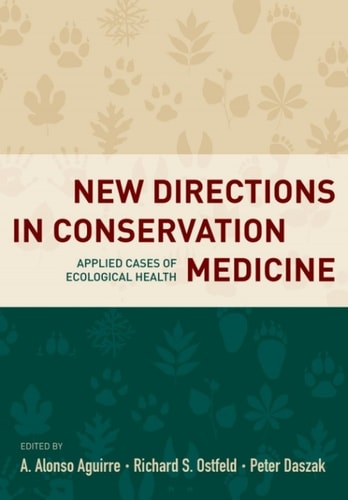
New Directions in Conservation Medicine: Applied Cases of Ecological Health
0
0
As an Amazon Associate and affiliate partner, Menrva Books earns from qualifying purchases. Learn more
Author Description
In recent years, species and ecosystems have been threatened by many anthropogenic factors manifested in local and global declines of populations and species. Although we consider conservation medicine an emerging field, the concept is the result of the long evolution of transdisciplinary thinking within the health and ecological sciences and the better understanding of the complexity within these various fields of knowledge. Conservation medicine was born from the cross fertilization of ideas generated by this new transdisciplinary design. It examines the links among changes in climate, habitat quality, and land use; emergence and re-emergence of infectious agents, parasites and environmental contaminants; and maintenance of biodiversity and ecosystem functions as they sustain the health of plant and animal communities including humans.During the past ten years, new tools and institutional initiatives for assessing and monitoring ecological health concerns have emerged: landscape epidemiology, disease ecological modeling and web-based analytics. New types of integrated ecological health assessment are being deployed; these efforts incorporate environmental indicator studies with specific biomedical diagnostic tools. Other innovations include the development of non-invasive physiological and behavioral monitoring techniques; the adaptation of modern molecular biological and biomedical techniques; the design of population level disease monitoring strategies; the creation of ecosystem-based health and sentinel species surveillance approaches; and the adaptation of health monitoring systems for appropriate developing country situations. New Directions of Conservation Medicine: Applied Cases of Ecological Health addresses these issues with relevant case studies and detailed applied examples. New Directions of Conservation Medicine challenges the notion that human health is an isolated concern removed from the bounds of ecology and species interactions. Human health, ani
Menrva's Summary
THE THESIS
This volume investigates the intersection of human, animal, and environmental health, arguing that ecological integrity is a prerequisite for global health stability. The authors, A. Alonso Aguirre, Peter Daszak, and Richard Ostfeld, are prominent experts in the fields of conservation medicine and disease ecology. They synthesize transdisciplinary research to demonstrate how anthropogenic factors, such as climate change and land-use shifts, directly influence the emergence of infectious diseases and the degradation of biodiversity. The text provides a framework for integrating biomedical diagnostics with ecological monitoring to address these complex, interconnected challenges.
THE SCOPE MAP
What You Will Find
- Analysis of the links between climate change, habitat quality, and infectious disease emergence.
- Methodologies for landscape epidemiology and disease ecological modeling.
- Case studies demonstrating the application of non-invasive physiological and behavioral monitoring techniques.
- Strategies for implementing ecosystem-based health surveillance in diverse global contexts.
THE AUTHORITY PERSPECTIVE
Experts recognize this work as a significant contribution to the field of conservation medicine, providing a bridge between theoretical ecology and practical biomedical application. Readers frequently note the technical density of the prose, which serves as a comprehensive reference for researchers and practitioners in public health and environmental science.
Page Count:
672
Publication Date:
2012-01-01
Publisher:
Oxford University Press
ISBN-10:
0199909059
ISBN-13:
9780199909056
Science
Biology
Allied Health
Epidemiology
Ecology
Medical
Public Health
Medicine
Community Tags
Similar Books




Reader Comments
Share Your Thoughts
No comments yet. Be the first to share your thoughts!