
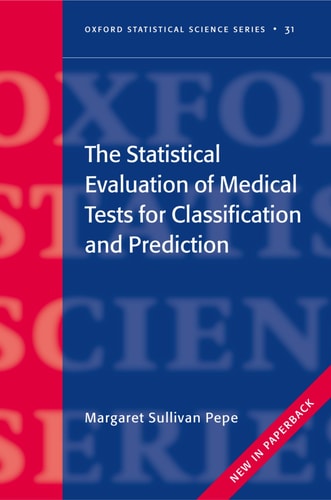
The Statistical Evaluation of Medical Tests for Classification and Prediction
0
0
As an Amazon Associate and affiliate partner, Menrva Books earns from qualifying purchases. Learn more
Author Description
The use of clinical and laboratory information to detect conditions and predict patient outcomes is a mainstay of medical practice. Modern biotechnology offers increasing potential to develop sophisticated tests for these purposes. This book describes the statistical concepts and techniques for evaluating the accuracy of medical tests. Worked examples include applications to cancer biomarker studies, prospective disease screening studies, diagnostic radiology studies and audiology testing studies. The statistical methodology can be broadly applied for evaluating classifiers and to problems beyond medical settings. Several measures for quantifying test accuracy are described including the Receiver Operating Characteristic Curve. Pepe presents statistical procedures for the estimation and comparison of those measures among tests. Regression frameworks for assessing factors that influence test accuracy and for comparing tests while adjusting for such factors are presented. The sequence of research steps involved in the development of a test is considered in some detail. Sample size calculations and other issues pertinent to study design are described for tests at various phases of development. In addition, the impacts of missing data and imperfect reference data are addressed. These problems often occur in practice, and modern statistical procedures for dealing with them are discussed. Additional topics that are covered include: meta-analysis for summarizing the results of multiple studies of a test; the evaluation of markers for predicting event time data; and procedures for combining the results of multiple tests to improve classification. This book should be of interest to quantitative researchers and practicing statisticians. The book also covers the theoretical foundations for statistical inference and should therefore be of interest to academic statisticians including those involved in statistical methodological research in this field.
Menrva's Summary
THE THESIS
This book investigates the statistical frameworks and methodologies required to accurately evaluate medical tests used for disease classification and patient outcome prediction. Margaret Sullivan Pepe, a prominent researcher in biostatistics, synthesizes complex statistical concepts to provide a rigorous guide for evaluating diagnostic accuracy. The text bridges the gap between theoretical statistical inference and practical application in clinical settings, offering a structured approach to test development and validation.
THE SCOPE MAP
What You Will Find
- Statistical measures for test accuracy including Receiver Operating Characteristic (ROC) curves
- Regression frameworks for assessing factors influencing test performance
- Methodologies for sample size calculation and study design
- Techniques for handling missing data and imperfect reference standards
- Meta-analysis procedures for summarizing multiple diagnostic studies
Scope Limits
- The text assumes a strong background in statistical theory and quantitative methods
- It does not cover basic introductory statistics or general clinical medicine outside of testing contexts
THE AUTHORITY PERSPECTIVE
Experts and practitioners in the field of biostatistics recognize this work as a foundational text for the evaluation of diagnostic and prognostic markers. Readers frequently note the high level of technical density, making it a standard reference for academic researchers and professional statisticians.
Page Count:
320
Publication Date:
2003-01-01
Publisher:
OUP Oxford
ISBN-10:
019158861X
ISBN-13:
9780191588617
Medical Statistics
Mathematics
Medical
Data Analysis
Epidemiology
Biostatistics
Clinical Research
Public Health
Allied Health
Community Tags
Other Editions(4)

Similar Books













Reader Comments
Share Your Thoughts
No comments yet. Be the first to share your thoughts!