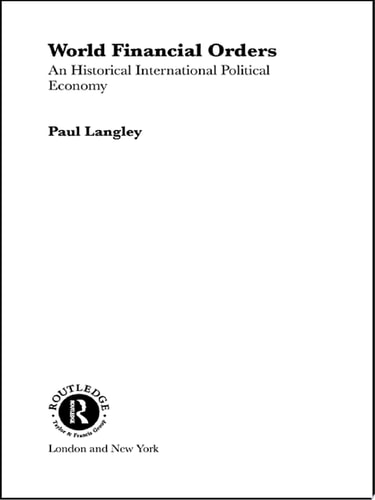
World Financial Orders
0
0
As an Amazon Associate and affiliate partner, Menrva Books earns from qualifying purchases. Learn more
Author Description
In World Financial Orders, Langley challenges the predominance of neo-liberalism as a mode of knowledge about contemporary world finance, and claims that it neglects the social and political bases as well as the malign consequences of change. He looks to the field of International Political Economy (IPE) to construct an alternative mode of knowledge, one that critically restores society and politics. An 'historical' approach to IPF, is advanced that accounts for modern world finance since the seventeenth century as a succession of structurally distinct hierarchical social orders. Comparative historical inquiry across modern world finance reveals the unique character of the contemporary order. This order combines new forms of credit practices, decentralised and de-territorial spatiality, change in the very nature of financial power, unprecedented multilateral governance arrangements and contradictions that threaten its own future. This book will be of interest to those working in the field of IPE and to those scholars, researchers and students from across the social sciences who seek to challenge the common-sense, neo-liberal explanation of contemporary world finance.
Menrva's Summary
THE THESIS
This book investigates the limitations of neo-liberal frameworks in explaining contemporary world finance by proposing an alternative historical approach rooted in International Political Economy. Paul Langley, a scholar in the field of International Political Economy, argues that current dominant economic theories overlook the social and political foundations of financial systems. By examining the evolution of finance since the seventeenth century, he constructs a framework that restores the importance of social structures and political power to the study of global markets.
THE SCOPE MAP
What You Will Find
- A historical analysis of world finance spanning from the seventeenth century to the present day.
- A critique of neo-liberalism as a primary mode of knowledge in contemporary financial studies.
- An examination of modern credit practices and decentralized spatiality in global markets.
- A structural analysis of hierarchical social orders within financial systems.
THE AUTHORITY PERSPECTIVE
Scholars in the field of International Political Economy recognize this work as a significant contribution to critical financial studies. Readers frequently note the academic density of the prose and its utility for researchers seeking to challenge conventional economic narratives.
Page Count:
208
Publication Date:
2003-01-01
Publisher:
London ; Routledge, 2002.
ISBN-10:
0203166833
ISBN-13:
9780203166833
History
Economics
Finance