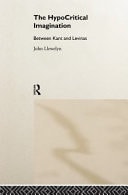
The Hypocritical Imagination: Between Kant and Levinas
0
0
As an Amazon Associate and affiliate partner, Menrva Books earns from qualifying purchases. Learn more
Author Description
For Philosophers Such As Kant, The Imagination Is The Starting Point For All Thought. For Others, Such As Wittgenstein, What Is Important Is Only How The Word 'imagination' Is Used. In Spite Of The Attention The Imagination Has Received From Major Philosophers, Remarkably Little Has Been Written About The Radically Different Interpretations They Have Made Of It. The Hypocritical Imagination: Between Kant And Levinas Is An Outstanding Contribution To This Vaccuum. Focusing On Kant And Levinas, John Llewelyn Takes Us On A Dazzling Tour Of The Philosophical Imagination. He Shows Us That Despite The Different Treatments They Accord To The Imagination, There Is Much To Be Gained From Comparing These Two Key Thinkers. From Kant, Llewelyn Shows How The Imagination Is The Common Root Of All Understanding. He Contrasts This With The Thought Of Emmanuel Levinas, For Whom The Imagination Plays An Ambivalent Role Both As Necessary For And A Threat To Recognition Of The Other. John Llewelyn Also Introduces The Importance Of The Work Of Heidegger Schelling, Hegel, Arendt And Derrida On The Imagination And What This Work Can Tell Us About The Relationship Between The Imagination And Ethics, Aesthetics And Literature. The Hypocritical Imagination: Between Kant And Levinas Is A Brilliant Reading Of A Neglected But Important Philosophical Theme And Is Essential Reading For Those In Contemporary Philosophy, Art Theory And Literature.
Menrva's Summary
THE THESIS
This work investigates the divergent and often contradictory roles assigned to the imagination within the philosophical frameworks of Immanuel Kant and Emmanuel Levinas. John Llewelyn, a scholar of continental philosophy, utilizes a comparative methodology to bridge the gap between Kant’s view of the imagination as a foundational cognitive faculty and Levinas’s more skeptical, ethical critique. By examining these two poles, the author constructs a rigorous argument regarding how the imagination functions as both a mechanism for understanding and a potential obstacle to the ethical recognition of the Other.
THE SCOPE MAP
What You Will Find
- A comparative analysis of the imagination as a cognitive root versus an ethical threat.
- Integration of secondary philosophical perspectives from Heidegger, Schelling, Hegel, Arendt, and Derrida.
- Examination of the intersection between imagination and the fields of ethics, aesthetics, and literature.
- A systematic critique of how philosophical discourse has historically neglected the varied interpretations of the imaginative faculty.
THE AUTHORITY PERSPECTIVE
Scholars and students of continental philosophy frequently identify this text as a vital resource for understanding the evolution of the imagination in modern thought. Experts note the high level of academic density in the prose, recommending it primarily for those already familiar with the foundational works of Kant and Levinas.
Page Count:
288
Publication Date:
2008-01-01
Publisher:
Taylor & Francis Group
ISBN-10:
0203187776
ISBN-13:
9780203187777
Philosophy
Ethics
Aesthetics
Continental Philosophy
Literary theory
Community Tags
Similar Books