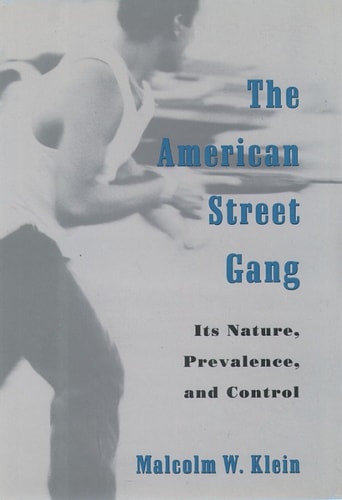
The American Street Gang: Its Nature, Prevalence, and Control
0
0
As an Amazon Associate and affiliate partner, Menrva Books earns from qualifying purchases. Learn more
Author Description
When the Soviet Union collapsed, the White House announced with great fanfare that 100 FBI counterintelligence agents would be reassigned. Their new target: street gangs. Americans--filled with fear of crack-dealing gangs--cheered the decision, as did many big-city police departments. But this highly publicized move could be an experience in futility, suggests Malcolm Klein: for one thing, most street gangs have little to do with the drug trade.The American Street Gang provides the finest portrait of this subject ever produced--a detailed accounting, through statistics, interviews, and personal experience, of what street gangs are, how they have changed, their involvement in drug sales, and why we have not been able to stop them. Klein has been studying street gangs for more than thirty years, and he brings a sophisticated understanding of the problem to bear in this often surprising book. In contrast to the image of rigid organization and military-style leadership we see in the press, he writes, street gangs are usually loose bodies of associates, with informal and multiple leadership. Street gangs, he makes clear, are quite distinct from drug gangs--though they may share individual members. In a drug-selling operation tight discipline is required--the members are more like employees--whereas street gangs are held together by affiliation and common rivalries, with far less discipline. With statistics and revealing anecdotes, Klein offers a strong critique of the approach of many law enforcement agencies, which have demonized street gangs while ignoring the fact that they are the worst possible bodies for running disciplined criminal operations--let alone colonizing other cities. On the other hand, he shows that street gangs do spur criminal activity, and he demonstrates the shocking rise in gang homicides and the proliferation of gangs across America. Ironically, he writes, the liberal approach to gangs advocated by many (assigning a social worker to a gang, organi
Menrva's Summary
THE THESIS
What is the true nature of the American street gang, and why have conventional law enforcement and social intervention strategies largely failed to mitigate their prevalence? Malcolm W. Klein, a veteran researcher with over three decades of field experience, argues that the public and political perception of street gangs as highly organized, drug-trafficking syndicates is fundamentally flawed. By contrasting the reality of loose, informal gang structures with the rigid, military-style organizations often depicted in media, Klein provides a framework for understanding why current policy approaches are frequently ineffective.
THE SCOPE MAP
What You Will Find
- Longitudinal analysis of gang evolution and structural dynamics over thirty years.
- Comparative study between traditional street gangs and disciplined drug-trafficking organizations.
- Statistical data on gang-related homicides and geographic proliferation.
- Critique of common intervention strategies, including social work and aggressive policing.
Scope Limits
- The text does not provide a comprehensive manual for individual gang rehabilitation or specific localized tactical police manuals.
- It focuses primarily on the American context and does not extend its analysis to international gang structures.
THE AUTHORITY PERSPECTIVE
Experts in criminology and sociology frequently cite this work as a foundational text for understanding the structural realities of gang life. Readers often note the academic density of the prose, which balances rigorous statistical analysis with insightful field observations.
Page Count:
280
Publication Date:
1997-01-01
Publisher:
Oxford University Press
ISBN-10:
0190283394
ISBN-13:
9780190283391
Public Policy
Social Science
Sociology
Criminology
Law Enforcement
Community Tags
Other Editions(2)

Similar Books














Reader Comments
Share Your Thoughts
No comments yet. Be the first to share your thoughts!