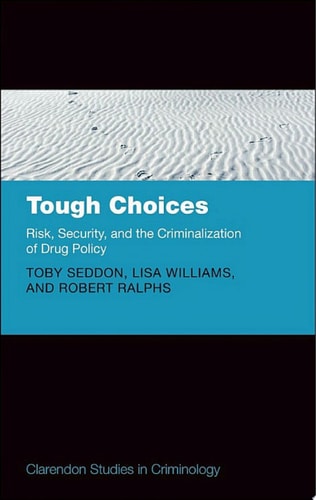
Tough Choices: Risk, Security and the Criminalization of Drug Policy
0
0
As an Amazon Associate and affiliate partner, Menrva Books earns from qualifying purchases. Learn more
Author Description
In recent years, British drug policy has undergone a transformation: tackling 'drug-driven' crime through criminal justice interventions has arguably become the central priority and focus. The 'criminal justice turn', as the authors refer to current UK drugs policy, is based on three simple and linked assumptions: drug-driven property crime is a major driver of local area crime rates, especially in deprived neighbourhoods; the criminal justice system can be used to target these drug-motivated offenders and direct them into treatment; and treatment can lead to significant reductions in their offending. Tough Choices: Risk, Security and the Criminalization of Drug Policy explores a series of questions about the 'criminal justice' turn in British drugs policy, from why it happened at all to what led policy to unfold in the way that it did, by analyzing policy documents and over 200 interviews conducted with key players in the policy development and implementation process. At the practice level, the authors explore how the strategic vision of the drug-crime 'problem' has shaped the ways in which drug-using offenders are identified, targeted and managed - in other words, why the implementation of the Drug Interventions Programme on the ground has taken the forms that it has. This is addressed through a detailed examination of practice in three local areas. Both the emergence of this new policy direction and its implementation in practice can best be understood as part of a wider transformation in governance in which risk-based thinking has become central to the ways in which we seek to address our contemporary insecurities. The book is based on a 30-month ESRC-funded research project on the Drug Interventions Programme and draws on the extensive empirical data generated during the project.
Menrva's Summary
THE THESIS
This book investigates the shift in British drug policy toward a criminal justice-centered approach and the underlying assumptions that drive this transformation. The authors, Lisa Williams, Robert Ralphs, and Toby Seddon, utilize their extensive research from a 30-month ESRC-funded project to analyze how risk-based governance shapes the management of drug-using offenders. They argue that the current focus on treating drug-motivated crime as a primary driver of local insecurity has fundamentally altered the implementation of policy at the local level.
THE SCOPE MAP
What You Will Find
- Analysis of the 'criminal justice turn' in UK drug policy.
- Examination of the Drug Interventions Programme (DIP) implementation.
- Empirical data derived from over 200 interviews with policy stakeholders.
- Case studies focusing on practice in three distinct local areas.
Scope Limits
- The study is geographically confined to the United Kingdom.
- The research focuses primarily on the period surrounding the implementation of the Drug Interventions Programme.
THE AUTHORITY PERSPECTIVE
Experts recognize this work as a significant empirical contribution to the study of criminal justice and governance. Readers frequently note the academic density of the prose and the rigorous methodology applied to the analysis of policy implementation.
Page Count:
235
Publication Date:
2012-01-01
Publisher:
OUP Oxford
ISBN-10:
0191634239
ISBN-13:
9780191634239
Sociology
Public Policy
Professional Career & Trade
Social Science
Drug Policy
Law Enforcement
Criminology
Community Tags
Similar Books