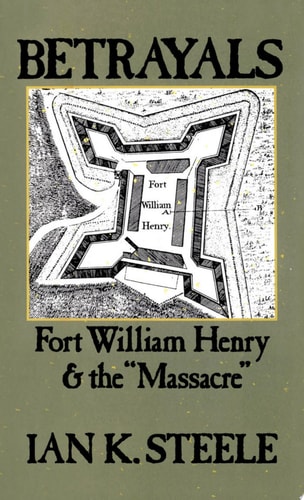
Betrayals: Fort William Henry and the "Massacre"
0
0
As an Amazon Associate and affiliate partner, Menrva Books earns from qualifying purchases. Learn more
Author Description
On the morning of August 9, 1757, British and colonial officers defending the besieged Fort William Henry surrendered to French forces, accepting the generous "parole of honor" offered by General Montcalm. As the column of British and colonials marched with their families and servants to Fort Edward some miles south, they were set upon by the Indian allies of the French. The resulting "massacre," thought to be one of the bloodiest days of the French and Indian War, became forever ingrained in American myth by James Fenimore Cooper's classic novel The Last of the Mohicans. In Betrayals, historian Ian K. Steele gives us the true story behind Cooper's famous book, bringing to life men such as British commander of Fort William Henry George Monro, English General Webb, his French counterpart Montcalm, and the wild frontier world of Natty Bumppo. The Battle of Lake George and the building of the fort marked the return of European military involvement in intercolonial wars, producing an explosive mixture of the contending martial values of Indians, colonials, and European regulars. The Americans and British who were attacked after surrendering, as well as French officers and their Indian allies (the latter enraged by the small amount of English booty allowed them by the French), all felt deeply betrayed. Contemporary accounts of the victims--whose identities Steele has carefully reconstructed from newly discovered sources--helped to create a powerful, racist American folk memory that still resonates today. Survivors included men and women who were adopted into Indian tribes, sold to Canadians in a well-established white servant trade, or jailed in Canada or France as prisoners of war. Explaining the motives for the most notorious massacre of the colonial period, Steele offers a gripping tale of a fledgling America, one which places the tragic events of the Seven Years' War in a fresh historical context. Anyone interested in the fact behind the fiction will find it fascinating.
Menrva's Summary
THE THESIS
This work investigates the historical reality behind the 1757 siege of Fort William Henry and the subsequent massacre, questioning how these events were transformed into American myth. Ian K. Steele, a historian specializing in colonial North America, utilizes newly discovered primary sources to reconstruct the experiences of the victims and the strategic failures of the British, French, and Indian participants. The book argues that the event was defined by conflicting martial values and mutual betrayals, which ultimately fueled a lasting and racially charged American folk memory.
THE SCOPE MAP
What You Will Find
- Detailed analysis of the siege of Fort William Henry and the surrender negotiations.
- Reconstructed identities of the massacre victims based on archival research.
- Examination of the cultural clash between European military regulars, colonial forces, and Indian allies.
- Investigation into the aftermath, including the fates of survivors who were adopted, enslaved, or imprisoned.
Scope Limits
- The book focuses primarily on the events surrounding the 1757 siege and does not provide a comprehensive history of the entire Seven Years' War.
- It does not attempt to provide a literary critique of James Fenimore Cooper’s work beyond its role in shaping historical memory.
THE AUTHORITY PERSPECTIVE
Historians and scholars of the colonial period frequently cite this work for its meticulous archival research and its ability to demystify long-standing cultural myths. Readers often note the academic density of the prose, which provides a rigorous and sobering look at the complexities of frontier warfare.
Page Count:
257
Publication Date:
1990-01-01
Publisher:
Oxford University Press
ISBN-10:
0190281634
ISBN-13:
9780190281632
History
History of the Americas
Military History
Ethnic Studies
French and Indian War
American History
Native American
Community Tags
Similar Books