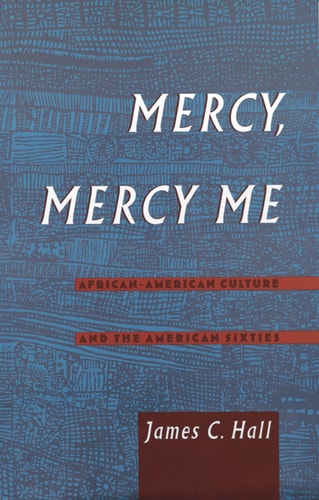
Mercy, Mercy Me: African-American Culture and the American Sixties
0
0
As an Amazon Associate and affiliate partner, Menrva Books earns from qualifying purchases. Learn more
Author Description
Using an interdisciplinary approach, this book argues that American artistry in the 1960s can be understood as one of the most vital and compelling interrogations of modernity. James C. Hall finds that the legacy of slavery and the resistance to it have by necessity made African Americans among the most incisive critics and celebrants of the Enlightenment inheritance. Focusing on the work of six individuals--Robert Hayden, William Demby, Paule Marshall, John Coltrane, Romare Bearden, and W.E.B. DuBois--Mercy, Mercy Me seeks to recover an American tradition of evaluating the "dialectic of the Enlightenment."
Menrva's Summary
THE THESIS
This book investigates how African American artistry during the 1960s functioned as a critical interrogation of modernity and the Enlightenment inheritance. James C. Hall, a scholar of African American literature and culture, utilizes an interdisciplinary framework to analyze how the historical legacy of slavery positioned Black artists as unique observers of American democratic ideals. By examining the intersection of aesthetic production and political resistance, the author argues that these creators provided a necessary critique of the contradictions inherent in Western modernity.
THE SCOPE MAP
What You Will Find
- Analysis of the dialectic of the Enlightenment within 1960s American culture
- Interdisciplinary study combining literary analysis, musicology, and visual arts
- Focused case studies on six prominent figures: Robert Hayden, William Demby, Paule Marshall, John Coltrane, Romare Bearden, and W.E.B. DuBois
Scope Limits
- Does not provide a comprehensive survey of all African American artistic movements of the decade
- Does not focus on popular commercial music or mainstream political history outside of the selected artists
THE AUTHORITY PERSPECTIVE
Scholars and critics frequently cite this work for its rigorous application of cultural theory to a diverse range of artistic mediums. Experts highlight the text as a significant contribution to the study of how African American intellectual traditions shaped the broader understanding of the American Sixties.
Page Count:
295
Publication Date:
2001-01-01
Publisher:
Oxford University Press
ISBN-10:
0190282614
ISBN-13:
9780190282615
History
1960s
Literary Criticism
Ethnic Studies
African American
United States
Art History
Community Tags
Similar Books