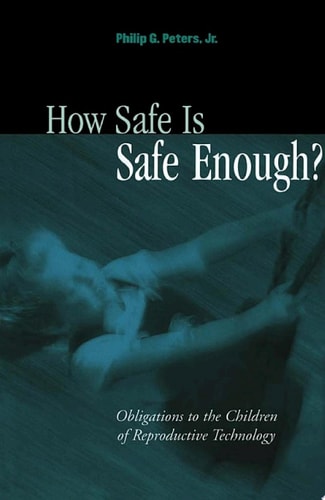
How Safe Is Safe Enough?: Obligations to the Children of Reproductive Technology
0
0
As an Amazon Associate and affiliate partner, Menrva Books earns from qualifying purchases. Learn more
Author Description
This book offers a comprehensive roadmap for determining when and how to regulate risky reproductive technologies on behalf of future children. First, it provides three benchmarks for determining whether a reproductive practice is harmful to the children it produces. This framework synthesizes and extends past efforts to make sense of our intuitive, but paradoxical, belief that reproductive choices can be both life-giving and harmful. Next, it recommends a process for reconciling the interests of future children with the reproductive liberty of prospective parents. The author rejects a blanket preference for either parental autonomy or child welfare and proposes instead a case-by-case inquiry that takes into account the nature and magnitude of the proposed restrictions on procreative liberty, the risk of harm to future children, and the context in which the issue arises. Finally, he applies this framework to four past and future medical treatments with above average risk, including cloning and genetic engineering. Drawing lessons from these case studies, Peters criticizes the current lack of regulatory oversight and recommends both more extensive pre-market testing and closer post-market monitoring of new reproductive technologies. His moderate, pragmatic approach will be widely appreciated.
Menrva's Summary
THE THESIS
This book investigates the ethical and regulatory challenges of balancing reproductive liberty with the welfare of children born through emerging medical technologies. Philip G. Peters Jr., a legal scholar, utilizes a framework of risk assessment and parental rights to address the paradox of reproductive choices that are simultaneously life-giving and potentially harmful. He argues against a binary approach, proposing instead a nuanced, case-by-case evaluation of reproductive practices.
THE SCOPE MAP
What You Will Find
- Three specific benchmarks for evaluating harm to children produced by reproductive technologies
- A proposed methodology for reconciling parental autonomy with child welfare
- Case studies on cloning and genetic engineering
- Recommendations for pre-market testing and post-market monitoring of medical procedures
Scope Limits
- The text does not provide an exhaustive legal code for every possible future reproductive technology
- It does not focus on the theological or purely philosophical arguments regarding the sanctity of life
THE AUTHORITY PERSPECTIVE
Experts in bioethics and law recognize this work as a pragmatic contribution to the field of reproductive regulation. Readers frequently note the clarity of the author's framework and the balanced approach he takes toward complex, contentious medical issues.
Page Count:
263
Publication Date:
2004-01-01
Publisher:
Oxford University Press
ISBN-10:
0190288973
ISBN-13:
9780190288976
Political Aspects
Allied Health
Public Policy
Medical Ethics
Bioethics
Reproductive Technology
Medical
Law
Sociology
Community Tags
Similar Books