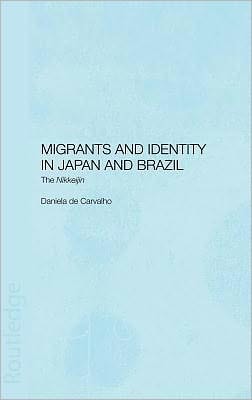
Migrants and Identity in Japan and Brazil: The Nikkeijin
0
0
As an Amazon Associate and affiliate partner, Menrva Books earns from qualifying purchases. Learn more
Author Description
Economic and social difficulties at the beginning of the 20th century caused many Japanese to emigrate to Brazil. The situation was reversed in the 1980s as a result of economic downturn in Brazil and labour shortages in Japan. This book examines the construction and reconstruction of the ethnic identities of people of Japanese descent, firstly in the process of emigration to Brazil up to the 1980s, and secondly in the process of return migration to Japan in the 1990s. The closed nature of Japan's social history means that the effect of return migration' can clearly be seen. Japan is to some extent a unique sociological specimen owing to the absence of any tradition of receiving immigrants. This book is first of all about migration, but also covers the important related issues of ethnic identity and the construction of ethnic communities. It addresses the issues from the dual perspective of Japan and Brazil. The findings suggest that mutual contact has led neither to a state of conflict nor to one of peaceful coexistence, but rather to an assertion of difference. It is argued that the Nikkeijin consent strategically to the social definitions imposed upon their identities and that the issue of the Nikkeijin presence is closely related to the emerging diversity of Japanese society.
Menrva's Summary
THE THESIS
This book investigates how the Nikkeijin, people of Japanese descent, construct and reconstruct their ethnic identities amidst the dual migration processes between Brazil and Japan. Daniela De Carvalho utilizes a sociological framework to analyze the historical emigration of Japanese to Brazil and the subsequent return migration of their descendants to Japan during the 1990s. By examining the social dynamics in both nations, the author argues that these migrants strategically navigate the social definitions imposed upon them, highlighting the evolving nature of Japanese societal diversity.
THE SCOPE MAP
What You Will Find
- Historical analysis of Japanese emigration to Brazil starting in the early 20th century.
- Examination of return migration patterns during the 1980s and 1990s.
- Sociological study of ethnic identity construction and community formation.
- Comparative perspective on the social integration challenges in Japan and Brazil.
THE AUTHORITY PERSPECTIVE
Experts recognize this work as a significant contribution to the study of transnational migration and the specific sociological challenges faced by the Nikkeijin. Scholars frequently cite the text for its clear articulation of how return migration impacts historically closed social systems like that of Japan.
Page Count:
202
Publication Date:
2003-01-01
Publisher:
Taylor & Francis Group
ISBN-10:
0203220714
ISBN-13:
9780203220719
Sociology
Brazil
Migration
Japan
Ethnic Studies
Japan emigration and immigration