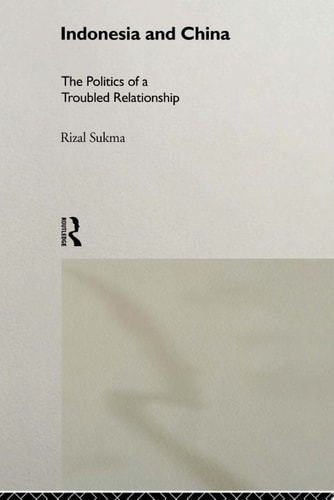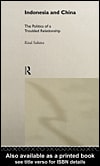
Indonesia and China
0
0
As an Amazon Associate and affiliate partner, Menrva Books earns from qualifying purchases. Learn more
Author Description
Indonesia broke off relations with China in 1967 and resumed them only in 1990. Rizal Sukma asks why. His answers shed light on Indonesia's foreign policy, the nature of the New Order's domestic politics, the mixed functions of diplomatic ties, the legitimacy of the new regime, and the role of President Suharto. Rizal Sukma argues that the matter of Indonesia restoring diplomatic ties with China is best understood in terms of the efforts made by the military-based New Order government to sustain its political legitimacy. To counter domestic challenges, it posed as the guardian of the state against communist threats. Normalisation of relations would have reduced its credibility. The military's resistance to pleas for this, especially from the Ministry of Foreign Affairs, served to justify its position as the only force capable of protecting the Republic from China. In 1989, the restoration of diplomatic relations came about because of major changes in the political power of the military and President Suharto's new goals. The analysis in this book proves that an absence as well as a presence of diplomatic relations may advance not only the external but the domestic interests of an incumbent government. This is the first major study of Indonesia and China's diplomatic relations under the New Order government. It will be illuminating for research students and lecturers in international politics, international relations, policy making and diplomacy.
Menrva's Summary
THE THESIS
This book investigates the strategic motivations behind the suspension and eventual restoration of diplomatic relations between Indonesia and China during the New Order era. Rizal Sukma, a prominent scholar of Indonesian foreign policy, utilizes historical records and political analysis to argue that the regime's diplomatic stance was primarily a tool for domestic political survival. By framing the absence of ties as a defense against communist threats, the military-backed government bolstered its own legitimacy and maintained internal control until shifting political priorities necessitated a change in 1990.
THE SCOPE MAP
What You Will Find
- Analysis of the 1967-1990 period of frozen diplomatic relations between Indonesia and China.
- Examination of the intersection between domestic political legitimacy and foreign policy decision-making.
- Evaluation of the role of President Suharto and the military in shaping state-level diplomatic strategy.
- Assessment of how the absence of international ties can serve the internal interests of an incumbent government.
THE AUTHORITY PERSPECTIVE
Scholars and students of international relations recognize this work as a foundational text for understanding the complexities of Indonesian foreign policy during the Suharto regime. Experts frequently highlight the book's clarity in linking domestic political maneuvers to broader diplomatic outcomes.
Page Count:
224
Publication Date:
2003-01-01
Publisher:
Taylor & Francis Group Plc
ISBN-10:
0203259815
ISBN-13:
9780203259818
History
Non-Fiction
Politics
Science
Außenpolitik
Government
International relations
Nonfiction
Diplomacy
Asian Studies
Au©enpolitik
Reference