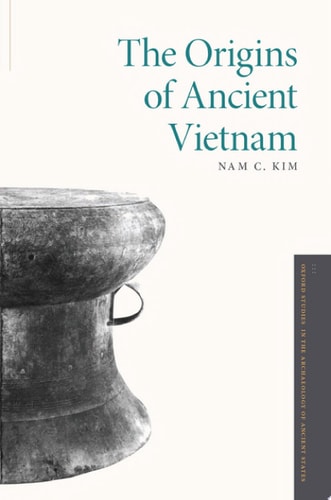
The Origins of Ancient Vietnam (Oxford Studies in the Archaeology of Ancient States)
0
0
As an Amazon Associate and affiliate partner, Menrva Books earns from qualifying purchases. Learn more
Author Description
The Origins of Ancient Vietnam explores the origins of civilization in the Red River Delta of Vietnam and how related studies can inform our understanding of ancient societies, generally, and the foundations of Vietnamese culture, specifically. Long believed to be the cradle of Vietnamese civilization, this area has been referenced by Vietnamese and Chinese writers for centuries, many recording colorful tales and legends about the region's prehistory. One of the most enduring accounts relates the story of the Au Lac Kingdom and its capital of Co Loa. Founded during the third century BC, according to legend, the fortified city's ramparts still stand today. However, there are ongoing debates about the origins of the site, the validity of the literary accounts, and the link between the prehistoric past and later Vietnamese societies. The Han Empire's later annexation of the region, combined with the problematic accounts found in the Chinese chronicles, further complicates these questions. Recent decades of archaeology in the region have provided new perspectives for examining these issues. The material record reveals indigenous trajectories of cultural change throughout the prehistoric period, culminating in the emergence of a politically sophisticated society. Specifically, new data indicate the founding of Co Loa by an ancient state, centuries before the Han arrival. In The Origins of Ancient Vietnam, Nam Kim synthesizes the archaeological evidence for this momentous development, placing Co Loa within a wider, global setting of emergent cities, states, and civilizations.
Menrva's Summary
THE THESIS
This work investigates the emergence of complex state-level societies in the Red River Delta of Vietnam, specifically addressing the historical and archaeological validity of the legendary Au Lac Kingdom and the fortified city of Co Loa. Nam C. Kim, an expert in the archaeology of Southeast Asia, synthesizes decades of material evidence to challenge traditional narratives derived from Chinese chronicles. By analyzing the transition from prehistoric cultures to politically sophisticated states, the author argues for an indigenous trajectory of development that predates the Han Empire's annexation of the region.
THE SCOPE MAP
What You Will Find
- Archaeological data from the Red River Delta region.
- Comparative analysis of global state formation and urban development.
- Critical evaluation of historical texts versus material evidence.
Scope Limits
- The text does not provide a comprehensive history of Vietnam post-Han annexation.
- It does not focus on the linguistic or genetic origins of the Vietnamese people.
THE AUTHORITY PERSPECTIVE
Scholars and archaeologists recognize this text as a significant contribution to the study of Southeast Asian state formation, particularly for its rigorous integration of archaeological data with historical legend. Readers frequently note the academic density of the prose, which is tailored for students and researchers interested in the intersection of material culture and historiography.
Page Count:
353
Publication Date:
2015-01-01
Publisher:
Oxford University Press
ISBN-10:
0190494018
ISBN-13:
9780190494018
History
Asian History
Asian Studies
Anthropology
Vietnam
Archaeology and history
Archaeology
Community Tags
Similar Books