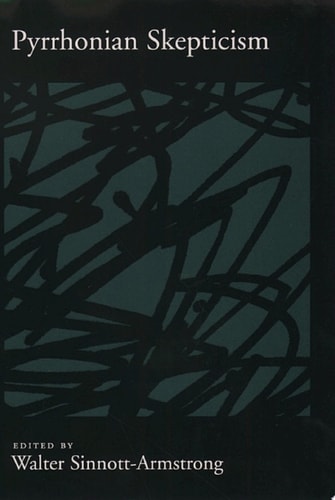
Pyrrhonian Skepticism
0
0
As an Amazon Associate and affiliate partner, Menrva Books earns from qualifying purchases. Learn more
Author Description
Throughout the history of philosophy, skepticism has posed one of the central challenges of epistemology. Opponents of skepticism--including externalists, contextualists, foundationalists, and coherentists--have focussed largely on one particular variety of skepticism, often called Cartesian or Academic skepticism, which makes the radical claim that nobody can know anything. However, this version of skepticism is something of a straw man, since virtually no philosopher endorses this radical skeptical claim. The only skeptical view that has been truly held--by Sextus, Montaigne, Hume, Wittgenstein, and, most recently, Robert Fogelin--has been Pyrrohnian skepticism. Pyrrhonian skeptics do not assert Cartesian skepticism, but neither do they deny it. The Pyrrhonian skeptics' doubts run so deep that they suspend belief even about Cartesian skepticism and its denial. Nonetheless, some Pyrrhonians argue that they can still hold "common beliefs of everyday life" and can even claim to know some truths in an everyday way.This edited volume presents previously unpublished articles on this subject by a strikingly impressive group of philosophers, who engage with both historical and contemporary versions of Pyrrhonian skepticism. Among them are Gisela Striker, Janet Broughton, Don Garrett, Ken Winkler, Hans Sluga, Ernest Sosa, Michael Williams, Barry Stroud, Robert Fogelin, and Roy Sorensen. This volume is thematically unified and will interest a broad spectrum of scholars in epistemology and the history of philosophy.
Menrva's Summary
THE THESIS
This volume investigates the distinct nature and philosophical viability of Pyrrhonian skepticism as a historical and contemporary challenge to traditional epistemology. Walter P. Sinnott-Armstrong, a prominent philosopher, curates this collection to move beyond the common focus on Cartesian skepticism. The contributors argue that Pyrrhonian skepticism—characterized by the suspension of belief rather than the denial of knowledge—represents a more authentic and rigorous skeptical tradition that warrants serious scholarly re-examination.
THE SCOPE MAP
What You Will Find
- Historical analysis of Pyrrhonian thought from Sextus Empiricus to Montaigne and Hume.
- Contemporary applications of skeptical arguments in modern epistemology.
- Critical essays by notable philosophers including Gisela Striker, Barry Stroud, and Robert Fogelin.
Scope Limits
- The text does not provide a comprehensive history of all skeptical schools.
- It does not offer a definitive resolution to the problem of knowledge, focusing instead on the mechanics of skeptical inquiry.
THE AUTHORITY PERSPECTIVE
Scholars and students of epistemology frequently cite this collection as a vital resource for understanding the nuances of Pyrrhonian thought. Experts highlight the volume for its ability to bridge the gap between historical philosophical texts and modern analytical debates.
Page Count:
245
Publication Date:
2004-01-01
Publisher:
Oxford University Press
ISBN-10:
0190290897
ISBN-13:
9780190290894
Philosophy
Linguistics
Epistemology
English
Academic
English & College Success
Skepticism
History & Surveys
Philosophy history
Community Tags
Similar Books