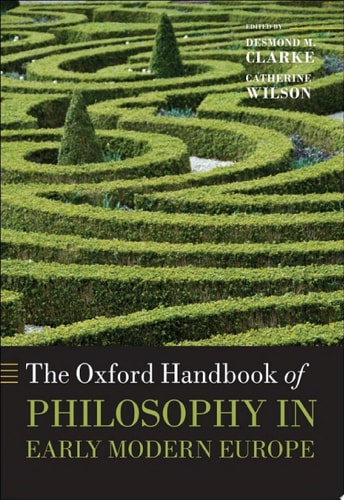
The Oxford Handbook of Philosophy in Early Modern Europe
0
0
As an Amazon Associate and affiliate partner, Menrva Books earns from qualifying purchases. Learn more
Author Description
In this Handbook twenty-six leading scholars survey the development of philosophy between the middle of the sixteenth century and the early eighteenth century. The five parts of the book cover metaphysics and natural philosophy; the mind, the passions, and aesthetics; epistemology, logic, mathematics, and language; ethics and political philosophy; and religion. The period between the publication of Copernicus's De Revolutionibus and Berkeley's reflections on Newton and Locke saw one of the most fundamental changes in the history of our way of thinking about the universe. This radical transformation of worldview was partly a response to what we now call the Scientific Revolution; it was equally a reflection of political changes that were no less fundamental, which included the establishment of nation-states and some of the first attempts to formulate a theory of international rights and justice. Finally, the Reformation and its aftermath undermined the apparent unity of the Christian church in Europe and challenged both religious beliefs that had been accepted for centuries and the interpretation of the Bible on which they had been based. The Handbook surveys a number of the most important developments in the philosophy of the period, as these are expounded both in texts that have since become very familiar and in other philosophical texts that are undeservedly less well-known. It also reaches beyond the philosophy to make evident the fluidity of the boundary with science, and to consider the impact on philosophy of historical and political events—explorations, revolutions and reforms, inventions and discoveries. Thus it not only offers a guide to the most important areas of recent research, but also offers some new questions for historians of philosophy to pursue and to have indicated areas that are ripe for further exploration.
Menrva's Summary
THE THESIS
This volume investigates the fundamental shifts in philosophical thought that occurred in Europe between the mid-sixteenth and early eighteenth centuries. Edited by Catherine Wilson and Desmond M. Clarke, the text compiles contributions from twenty-six scholars to analyze how the Scientific Revolution, the rise of the nation-state, and the Reformation reshaped the intellectual landscape. The authors argue that this era represents a critical transformation in human understanding of the universe, necessitating a re-examination of both canonical and neglected philosophical texts.
THE SCOPE MAP
What You Will Find
- Analysis of metaphysics, natural philosophy, and epistemology.
- Examination of the intersections between philosophy, mathematics, and language.
- Discussions on ethics, political theory, and the philosophy of religion.
- Contextualization of philosophical developments alongside historical events like the Scientific Revolution and the Reformation.
Scope Limits
- The text focuses primarily on the European tradition within the specified timeframe.
- It does not provide an exhaustive biography of every philosopher mentioned, focusing instead on thematic and systemic developments.
THE AUTHORITY PERSPECTIVE
Scholars and students of philosophy frequently cite this work as a comprehensive reference for understanding the transition from scholasticism to modern thought. Experts highlight the text for its academic rigor and its success in bridging the gap between historical context and philosophical inquiry.
Page Count:
609
Publication Date:
2013-01-01
Publisher:
OUP Oxford
ISBN-10:
0191654256
ISBN-13:
9780191654251
Philosophy
Philosophy history
Linguistics
History & Surveys
Reference
European History
English
Early Modern
Intellectual History
English & College Success
Community Tags
Other Editions(5)

Similar Books



Reader Comments
Share Your Thoughts
No comments yet. Be the first to share your thoughts!