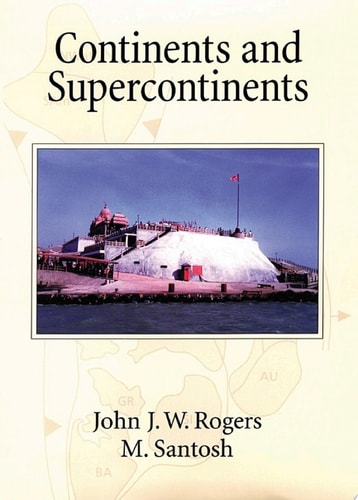
Continents and Supercontinents
0
0
As an Amazon Associate and affiliate partner, Menrva Books earns from qualifying purchases. Learn more
Author Description
To this day, there is a great amount of controversy about where, when and how the so-called supercontinents--Pangea, Godwana, Rodinia, and Columbia--were made and broken. Continents and Supercontinents frames that controversy by giving all the necessary background on how continental crust is formed, modified, and destroyed, and what forces move plates. It also discusses how these processes affect the composition of seawater, climate, and the evolution of life. Rogers and Santosh begin with a survey of plate tectonics, and go on to describe the composition, production, and destruction of continental and oceanic crust, and show that cratons or assemblies of cratons became the first true continents, approximately one billion years after the earliest continental crust evolved. The middle part of the book concentrates on supercontinents, beginning with a discussion of types of orogenic belts, distinguishing those that formed by closure of an ocean basin within the belt and those that formed by intracontinental deformation caused by stresses generated elsewhere. This information permits discrimination between models of supercontinent formation by accretion of numerous small terranes and by reorganization of large old continental blocks. This background leads to a description of the assembly and fragmentation of supercontinents throughout earth history. The record is most difficult to interpret for the oldest supercontinent, Columbia, and also controversial for Rodinia, the next youngest supercontinent. The configurations and pattern of breakup of Gondwana and Pangea are well known, but some aspects of their assembly are unclear. The book also briefly describes the histories of continents after the breakup of Pangea, and discusses how changes in the composition of seawater, climate, and life may have been affected by the sizes and locations of continents and supercontinents.
Menrva's Summary
THE THESIS
This text investigates the mechanisms behind the formation, assembly, and fragmentation of supercontinents throughout Earth's history. Authors John J. W. Rogers and M. Santosh, both established geologists, synthesize geological data to explain how continental crust evolves and how plate tectonic processes influence global climate, seawater composition, and biological evolution. The work provides a structured framework for understanding the transition from early cratons to the massive supercontinental cycles of Pangea, Gondwana, Rodinia, and Columbia.
THE SCOPE MAP
What You Will Find
- Comprehensive survey of plate tectonics and crustal dynamics
- Analysis of orogenic belt types and their role in continental assembly
- Historical reconstruction of supercontinent cycles from Columbia to Pangea
- Discussion on the correlation between continental positioning and environmental shifts
Scope Limits
- Does not provide an exhaustive history of every individual micro-continent
- Focuses primarily on large-scale tectonic models rather than localized geological mapping
THE AUTHORITY PERSPECTIVE
Experts recognize this work as a significant synthesis of tectonic theory and historical geology. Readers frequently note the academic density of the prose, which serves as a foundational resource for students and professionals interested in the long-term evolution of the Earth's crust.
Page Count:
297
Publication Date:
2004-01-01
Publisher:
Oxford University Press
ISBN-10:
019029020X
ISBN-13:
9780190290207
Science
Academic
Plate Tectonics
Continents
Paleogeography
Earth Science
Geophysics
Geology
Earth Sciences
Community Tags
Other Editions(3)
Similar Books




Reader Comments
Share Your Thoughts
No comments yet. Be the first to share your thoughts!