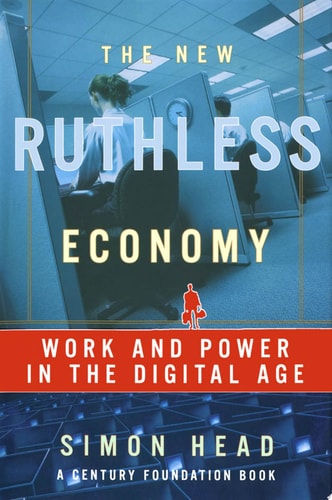
The New Ruthless Economy: Work and Power in the Digital Age
0
0
As an Amazon Associate and affiliate partner, Menrva Books earns from qualifying purchases. Learn more
Author Description
In the great boom of the 1990's, top management's compensation soared, but the wages of most Americans barely grew at all. This wages stagnation has baffled experts, but in The New Ruthless Economy, Simon Head points to information technology as the prime cause of this growing wage disparity. Many economists, technologists and business consultants have predicted that IT would liberate the work force, bringing self-managed work teams and decentralized decision making. Head argues that the opposite has happened. Reengineering, a prime example of how business processes have been computerized, has instead simplified the work of middle and lower level employees, fenced them in with elaborate rules, and set up digital monitoring to make sure that the rules are obeyed. This is true even in such high-skill professions as medicine, where decision-making software in the hands of HMO's decides the length of a patient's stay in hospital and determines the treatments patients will or will not receive. In lower-skill jobs, such as in the call center industry, workers are subject to the indignity of scripting software that lays out the exact conversation, line by line, which agents must follow when speaking with customers. Head argues that these computer systems devalue a worker's experience and skill, and subject employees to a degree of supervision which is excessive and demeaning. The harsh and often unstable work regime of reengineering also undermines the security of employees and so weakens their bargaining power in the workplace. Drawing upon ten years of research visiting work places across America, ranging from medical offices to machine tool plants, Head offers dramatic insight into the impact of information technology on the quality of working life in the United States.
Menrva's Summary
THE THESIS
Simon Head investigates how the integration of information technology into the modern workplace has systematically devalued labor and increased wage disparity rather than empowering the workforce. Drawing on a decade of field research, Head argues that corporate reengineering and computerized management systems have replaced human autonomy with rigid, rule-based digital monitoring. He posits that these systems effectively strip middle and lower-level employees of their professional judgment, shifting power dynamics heavily in favor of management.
THE SCOPE MAP
What You Will Find
- Analysis of reengineering processes in diverse sectors including healthcare and manufacturing.
- Examination of digital monitoring and scripting software in call centers.
- Critique of the impact of computerized decision-making on professional autonomy.
Scope Limits
- The analysis focuses primarily on the United States labor market during the late 20th century.
- The text does not provide a comprehensive history of global economic policy outside of the context of IT-driven workplace changes.
THE AUTHORITY PERSPECTIVE
Experts and labor economists frequently cite this work as a critical counter-narrative to the optimism surrounding the digital revolution in the workplace. Readers often note the detailed, observational nature of the research, which provides a sobering look at the practical implementation of management software in various industries.
Page Count:
238
Publication Date:
2003-01-01
Publisher:
Oxford University Press
ISBN-10:
0190290234
ISBN-13:
9780190290238
Economics
Professional Career & Trade
Sociology
Technology
Special Topics
Workplace Culture
Labor Studies
Globalization
Business Ethics
Community Tags
Similar Books