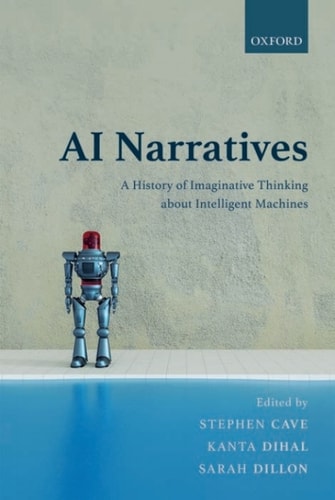
AI Narratives: A History of Imaginative Thinking about Intelligent Machines
0
0
As an Amazon Associate and affiliate partner, Menrva Books earns from qualifying purchases. Learn more
Author Description
This book is the first to examine the history of imaginative thinking about intelligent machines. As real Artificial Intelligence (AI) begins to touch on all aspects of our lives, this long narrative history shapes how the technology is developed, deployed and regulated. It is therefore a crucial social and ethical issue. Part I of this book provides a historical overview from ancient Greece to the start of modernity. These chapters explore the revealing pre-history of key concerns of contemporary AI discourse, from the nature of mind and creativity to issues of power and rights, from the tension between fascination and ambivalence to investigations into artificial voices and technophobia. Part II focuses on the twentieth and twenty-first-centuries in which a greater density of narratives emerge alongside rapid developments in AI technology. These chapters reveal not only how AI narratives have consistently been entangled with the emergence of real robotics and AI, but also how they offer a rich source of insight into how we might live with these revolutionary machines. Through their close textual engagements, these chapters explore the relationship between imaginative narratives and contemporary debates about AI's social, ethical and philosophical consequences, including questions of dehumanization, automation, anthropomorphisation, cybernetics, cyberpunk, immortality, slavery, and governance. The contributions, from leading humanities and social science scholars, show that narratives about AI offer a crucial epistemic site for exploring contemporary debates about these powerful new technologies.
Menrva's Summary
THE THESIS
This book investigates the historical evolution of imaginative narratives surrounding intelligent machines and how these stories influence the development, regulation, and ethical perception of contemporary artificial intelligence. The authors, Kanta Dihal, Sarah Dillon, and Stephen J. Cave, curate a collection of essays from leading humanities and social science scholars to analyze the intersection of fiction and technological advancement. By tracing these narratives from ancient Greece to the present day, the text argues that our cultural stories about AI are not merely entertainment but are foundational to how society understands and governs real-world machine intelligence.
THE SCOPE MAP
What You Will Find
- A chronological analysis of AI narratives spanning from ancient Greek myths to modern cyberpunk literature.
- Examination of recurring themes such as anthropomorphism, dehumanization, power dynamics, and the nature of creativity.
- Interdisciplinary perspectives on the relationship between technological progress and human anxiety regarding automation and governance.
Scope Limits
- The text focuses primarily on narrative and cultural history rather than providing a technical manual for AI engineering or computer science.
- It does not offer a predictive model for future technological breakthroughs, focusing instead on the historical and philosophical context of AI discourse.
THE AUTHORITY PERSPECTIVE
Experts and scholars in the humanities recognize this work as a foundational text for understanding the cultural baggage that accompanies modern AI development. Readers frequently note the academic density of the prose, which provides a rigorous framework for analyzing how fiction shapes our real-world technological trajectory.
Page Count:
448
Publication Date:
2020-01-01
Publisher:
OUP Oxford
ISBN-10:
0192586041
ISBN-13:
9780192586049
Philosophy
History
Professional Career & Trade
Special Topics
Earth Sciences
Sociology
Technology
Community Tags
Similar Books