
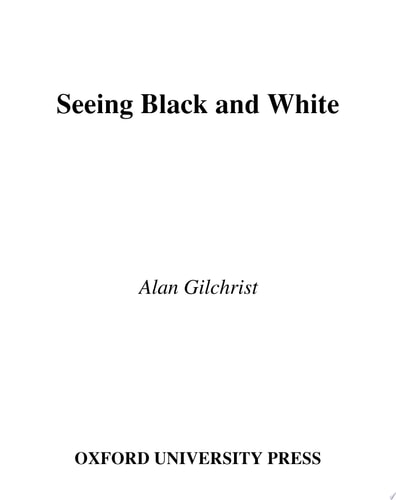
Seeing Black and White
0
0
As an Amazon Associate and affiliate partner, Menrva Books earns from qualifying purchases. Learn more
Author Description
How the human visual system determines the lightness of a surface, that is, its whiteness, blackness, or grayness, remains--like vision in general--a mystery. In fact, we have not even been able to create a machine that can determine, through an artificial vision system, whether an object is white, black, or gray. Although the photoreceptors in the eye are driven by light, the light reflected by a surface does not reveal its shade of gray. Depending upon the level of illumination, a surface of any shade of gray can reflect any amount of light.In Seeing Black and White Alan Gilchrist ties together over 30 years of his own research on lightness, and presents the first comprehensive, historical review of empirical work on lightness, covering the past 150 years of research on images ranging from the simple to the complex. He also describes and analyzes the many theories of lightness--including his own--showing what each can and cannot explain. Gilchrist highlights the forgotten-yet-exciting work done in the first third of the twentieth century, describing several crucial experiments and examining the brilliant but nearly unknown work of the Hungarian gestalt theorist, Lajos Kardos. Gilchrists review also includes a survey of the pattern of lightness errors made by humans, many of which result in delightful illusions. He argues that because these errors are not random, but systematic, they are the signature of our visual software, and so provide a powerful tool that can reveal how lightness is computed. Based on this argument and the concepts of anchoring, grouping, and frames of reference, Gilchrist presents a new theoretical framework that explains an unprecedented array of lightness errors. As both the first comprehensive overview of research on lightness and the first unified presentation of Gilchrists new theoretical framework Seeing Black and White will be an invaluable resource for vision scientists, cognitive psychologists, and cognitive neuroscientists.
Menrva's Summary
THE THESIS
How does the human visual system accurately perceive the lightness of a surface despite the ambiguity of reflected light? Alan L. Gilchrist, a prominent researcher in visual perception, synthesizes over three decades of his own experimental work with a comprehensive historical review of lightness research spanning 150 years. He argues that systematic errors in human perception are not random, but rather the signature of our internal visual software, and proposes a new theoretical framework based on the concepts of anchoring, grouping, and frames of reference to explain these phenomena.
THE SCOPE MAP
What You Will Find
- A 150-year historical review of empirical lightness research.
- Analysis of classical and contemporary theories of lightness perception.
- Examination of the work of Hungarian gestalt theorist Lajos Kardos.
- A new theoretical framework incorporating anchoring and grouping principles.
- A survey of systematic lightness errors and visual illusions.
Scope Limits
- The text does not provide a guide for building artificial vision systems.
- It does not cover the biological mechanics of the retina or photoreceptors in isolation.
THE AUTHORITY PERSPECTIVE
Experts identify this work as a foundational text for vision scientists and cognitive psychologists interested in the mechanics of perception. Readers frequently note the academic density of the prose, which requires a strong background in experimental psychology to fully appreciate the theoretical arguments presented.
Page Count:
447
Publication Date:
2006-01-01
Publisher:
Oxford University Press
ISBN-10:
0190293152
ISBN-13:
9780190293154
Psychology
Neuroscience
Vision Science
Perception
Community Tags
Other Editions(2)
Similar Books









Reader Comments
Share Your Thoughts
No comments yet. Be the first to share your thoughts!