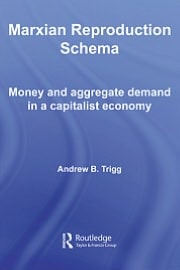
Marxian Reproduction Schema
0
0
As an Amazon Associate and affiliate partner, Menrva Books earns from qualifying purchases. Learn more
Author Description
In 1878 Karl Marx developed the reproduction schema: his model of how total capital is produced and reproduced. This is thought to be the first two-sector economic model ever constructed. Two key aspects of Marx’s writings are widely agreed to be undeveloped: The role of aggregate demand and the role of money. This book synthesizes various strands of economic thought to enable the reader to understand and clarify the structure of the reproduction schema. This synthesis will challenge prevailing orthodoxies.This book constructs a macro monetary model which draws on a wide range of economic theories, within both the Marxian economic tradition, and the tradition of Keynes, Kalecki, Domar, Sraffa and Leontief. Marxian economics has been dominated by supply-side thinking, including general equilibrium theory and pronouncements about the shortage of surplus value, whilst Post Keynesians have failed to take seriously the importance of reproduction and the multisectoral structure of capitalism. By locating aggregate demand and the circuit of money in the reproduction schema, this key book provides an analytical contribution to both Marxian and Post Keynesian economics.
Menrva's Summary
THE THESIS
This book investigates how the integration of aggregate demand and monetary circuits can clarify and expand Karl Marx’s original two-sector reproduction schema. Andrew Trigg, an economist specializing in Marxian and Post Keynesian thought, utilizes a comparative framework to address the historical underdevelopment of these specific components in Marx’s model. By synthesizing diverse economic traditions, the author constructs a macro monetary model designed to bridge the gap between supply-side Marxian analysis and multisectoral Post Keynesian theory.
THE SCOPE MAP
What You Will Find
- A comprehensive analysis of the two-sector economic model of capital reproduction.
- A macro monetary framework incorporating theories from Keynes, Kalecki, Domar, Sraffa, and Leontief.
- A critique of supply-side dominance within traditional Marxian economic thought.
- Methodological integration of aggregate demand and money circuits into multisectoral capitalism.
THE AUTHORITY PERSPECTIVE
Experts recognize this work as a significant analytical bridge between traditionally siloed economic schools of thought. Readers frequently note the technical density of the prose, which requires a foundational understanding of both Marxian and Post Keynesian economic models to fully grasp the author's arguments.
Page Count:
144
Publication Date:
2006-01-01
Publisher:
Taylor & Francis, Inc.
ISBN-10:
0203328655
ISBN-13:
9780203328651
Economics
Capitalism
Economic Theory
Macroeconomics
Marxism
Community Tags
Other Editions(3)

Similar Books