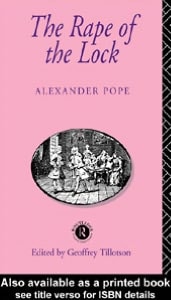
The Rape of the Lock
0
0
As an Amazon Associate and affiliate partner, Menrva Books earns from qualifying purchases. Learn more
Author Description
This edition reprints the text of Pope's classic poem — both the five-canto 1714 version and the facsimilie of the original 1712 version — together with a broad selection of documents. Including correspondence, poems, broadsides, reviews, and parodies, the documents focus special attention on Pope's life and career as well as on eighteenth-century poetic traditions and innovations, social habits and assumptions, historical events, and political implications. A general introduction providing historical and cultural background, a chronology of Pope's life and times, an introduction to each thematic group of documents, headnotes, extensive annotations, a selected bibliography, and a generous collection of maps, portraits, and illustrations make this volume a unique scholarly edition of this classic work of eighteenth-century literature.
Menrva's Summary
THE PULSE
A trivial social incident involving the theft of a lock of hair escalates into a mock-heroic conflict between two aristocratic families. Alexander Pope employs the conventions of the classical epic to frame a domestic dispute, elevating the vanity and social posturing of the eighteenth-century elite to the level of mythic struggle. The narrative follows the protagonist, Belinda, as she navigates a world governed by rigid social hierarchies and superficial rituals. Opposing her is the Baron, whose desire for her hair triggers a series of supernatural interventions and social skirmishes. The poem utilizes a structured, heroic couplet form to critique the moral and social priorities of the era.
INSIDE THE PAGES
- Utilization of the mock-heroic epic structure to parody classical literary traditions.
- Inclusion of supernatural machinery, such as sylphs and gnomes, to influence human behavior.
- Detailed descriptions of eighteenth-century fashion, card games, and social etiquette.
- Use of heroic couplets to maintain a rhythmic and satirical tone throughout the cantos.
- Satirical commentary on the vanity and obsession with reputation among the aristocracy.
- Integration of mythological allusions to contrast the triviality of the plot with grand historical narratives.
- Exploration of gender dynamics and the power imbalance within social courtship rituals.
- Sharp wit and irony directed at the moral failings of the upper class.
THE COLLECTIVE ECHO
Discussion often centers on Pope's technical mastery of the heroic couplet and his ability to sustain a satirical tone across five cantos. Readers frequently highlight the poem's effectiveness in transforming a minor social slight into a grand, epic-scale conflict. Critics often examine the balance between the poem's playful atmosphere and its underlying critique of eighteenth-century social values. The work is widely regarded as a definitive example of Augustan satire that remains relevant for its sharp observations on human vanity. Scholars emphasize how the poem functions as both a parody of classical literature and a mirror for the social habits of its time.
Page Count:
116
Publication Date:
1971-01-01
Publisher:
Methuen & Co.
ISBN-10:
0203359062
ISBN-13:
9780203359068
Poetry
Satire
British literature
Classical
Eighteenth Century
Rape of the lock Pope Alexander
Community Tags
Other Editions(12)






Similar Books




Reader Comments
Share Your Thoughts
No comments yet. Be the first to share your thoughts!