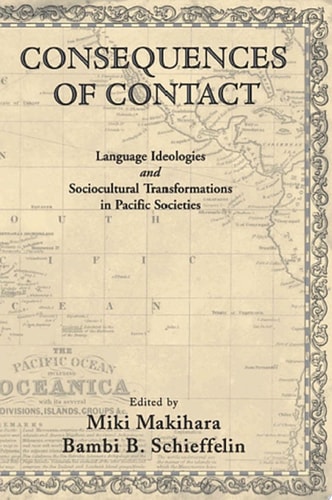
Consequences of Contact: Language Ideologies and Sociocultural Transformations in Pacific Societies
0
0
As an Amazon Associate and affiliate partner, Menrva Books earns from qualifying purchases. Learn more
Author Description
The Pacific is historically an area of enormous linguistic diversity, where talk figures as a central component of social life. Pacific communities also represent diverse contact zones, where between indigenous and introduced institutions and ideas; between local actors and outsiders; and involving different lingua franca, colonial, and local language varieties. Contact between colonial and post-colonial governments, religious institutions, and indigenous communities has spurred profound social change, irrevocably transforming linguistic ideologies and practices.Drawing on ethnographic and linguistic analyses, this edited volume examines situations of intertwined linguistic and cultural change unfolding in specific Pacific locations in the late twentieth and early twenty-first centuries. Its overarching concern is with the multiple ways that processes of historical change have shaped and been shaped by linguistic ideologies reflexive sensibilities about languages and language useheld by Pacific peoples and other agents of change. The essays demonstrate that language and linguistic practices are linked to changing consciousness of self and community through notions of agency, morality, affect, authority, and authenticity.In times of cultural contact, communities often experience language change at an accelerated rate. This is particularly so in small-scale communities where innovations and continuity routinely depend on the imagination, creativity, and charisma of fewer individuals. The essays in this volume provide evidence of this potential and a record of their voices, as they document new types of local actors, e.g., pastors, Bible translators, teachers, political activists, spirit mediums, and tour guides, some of whom introduce, innovate, legitimate, or resist new ideas and ways to express them through language. Drawing on and transforming metalinguistic concepts, local actors (re)shape language, reproducing and changing the communicative economy. In the proces
Menrva's Summary
THE THESIS
This volume investigates how historical contact between indigenous Pacific communities and external institutions has fundamentally altered linguistic ideologies and sociocultural practices. Editors Bambi B. Schieffelin and Miki Makihara compile ethnographic and linguistic research to argue that language serves as a primary site where notions of agency, morality, and authority are negotiated. By examining specific Pacific locales, the contributors demonstrate how local actors navigate and transform communicative economies in response to colonial and post-colonial pressures.
THE SCOPE MAP
What You Will Find
- Analysis of linguistic shifts in Pacific communities during the late twentieth and early twenty-first centuries.
- Examination of the role of local agents such as pastors, teachers, and political activists in language innovation.
- Theoretical frameworks linking metalinguistic concepts to changing consciousness of self and community.
Scope Limits
- The text focuses primarily on specific Pacific locations rather than providing a comprehensive survey of all Pacific linguistic history.
- It does not offer a universal theory of language contact, instead prioritizing localized ethnographic case studies.
THE AUTHORITY PERSPECTIVE
Scholars in the fields of linguistic anthropology and Pacific studies regard this volume as a significant contribution to the understanding of how language ideologies mediate social transformation. Readers frequently note the academic density of the prose, making it a specialized resource for researchers and advanced students interested in the intersection of culture and communication.
Page Count:
244
Publication Date:
2007-01-01
Publisher:
Oxford University Press
ISBN-10:
0190295937
ISBN-13:
9780190295936
Social change
English & College Success
English
Languages In Contact
Anthropology
Linguistics
Community Tags
Other Editions(2)
Similar Books







Reader Comments
Share Your Thoughts
No comments yet. Be the first to share your thoughts!