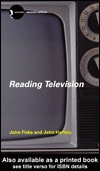
Reading Television
0
0
As an Amazon Associate and affiliate partner, Menrva Books earns from qualifying purchases. Learn more
Author Description
How is it that television has come to play such an important role in our culture? What, in fact, does it tell us, and how are its messages conveyed? What is it we find so satisfying in the format of television police series, or in quiz or sports programmes, that we enjoy watching them again and again? Reading Television was the book that first pushed the boundaries of television studies beyond the insights offered by cultural studies and textual analysis, creating a vibrant new field of study. Using the tools and techniques in this book, it is possible for everyone who has access to a television set to produce illuminating analyzes not only of the programmes themselves, but also of the culture which produces them.In this edition, Hartley reflects on the development of television studies since the publication of this enormously influential book, and updated suggestions. His new foreword both underlines and ensures the continuing relevance of this foundational text, which provides the ideal entry into an area of study crucial for anyone interested in contemporary culture.
Menrva's Summary
THE THESIS
How does television function as a cultural artifact, and what mechanisms allow it to convey complex social messages to its audience? John Fiske and John Hartley examine the structural and semiotic nature of television programming to understand its pervasive influence on contemporary society. By applying tools from cultural studies and textual analysis, the authors provide a framework for decoding the meanings embedded within popular television formats.
THE SCOPE MAP
What You Will Find
- Semiotic analysis of television genres including police procedurals, quiz shows, and sports broadcasts.
- Methodologies for decoding cultural messages and social values within broadcast media.
- Theoretical frameworks bridging the gap between textual analysis and cultural studies.
- Updated reflections on the evolution of television studies as an academic discipline.
THE AUTHORITY PERSPECTIVE
Experts recognize this work as a foundational text that established the parameters for modern television studies. Readers frequently note the academic density of the prose, which remains a standard reference for students and scholars of media culture.
Page Count:
176
Publication Date:
2004-01-01
Publisher:
Taylor & Francis Group Plc
ISBN-10:
0203387309
ISBN-13:
9780203387306
Television broadcasting
Social Aspects
Kritik
Télédiffusion
Fernsehen
Cable Television
Media Studies
Semiotics
Invloed
Semiotik
Aspect social
Televisie
Television
Communication
Sociology
Community Tags
Similar Books