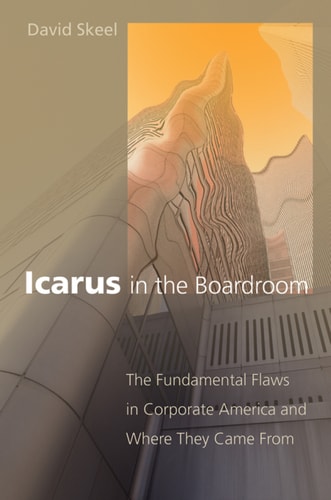
Icarus in the Boardroom: The Fundamental Flaws in Corporate America and Where They Came From
0
0
As an Amazon Associate and affiliate partner, Menrva Books earns from qualifying purchases. Learn more
Author Description
Americans have always loved risktakers. Like the Icarus of ancient Greek lore, however, even the most talented entrepreneurs can overstep their bounds. All too often, the very qualities that make Icaran executives special-- self-confidence, visionary insight, and extreme competitiveness--spur them to take misguided and even illegal chances. The Icaran failure of an ordinary entrepreneur isn't headline news. But put Icarus in the corporate boardroom and, as David Skeel vividly demonstrates, the ripple effects can be profound. Ever since the first large-scale corporations emerged in the nineteenth century, their ability to tap huge amounts of capital and the sheer number of lives they affect has meant that their executives play for far greater stakes. Excessive and sometimes fraudulent risks, competition, and the increasing size and complexity of organizations: these three factors have been at the heart of every corporate breakdown from 1873, when financial genius Jay Cooke collapsed, to the corporate scandals of the early 21st century. Compounding the scandals is an ongoing cat-and-mouse game between regulators' efforts to police the three factors that lead to Icarus Effect failures and efforts by corporate America to evade this regulation in the name of efficiency and flexibility. These efforts to side-step oversight can rapidly spiral out of control, setting the stage for the devastating corporate failures that punctuate American business history. But there is also a silver lining to the stunning failures: the outrage they provoke galvanizes public opinion in favor of corporate reform. The most important American business regulation has always been enacted in response to a major breakdown in corporate America. Today's business environment poses unprecedented perils for the average American as for the first time ever, more than half of Americans now own stock. Identifying the problems of the past, Skeel offers a strikingly new diagnosis of the fundamental flaws in c
Menrva's Summary
THE THESIS
This book investigates the recurring patterns of corporate failure in American history by examining the intersection of executive risk-taking, regulatory oversight, and the structural evolution of the modern corporation. David Skeel, a professor of corporate law, utilizes historical analysis and legal theory to argue that the same traits driving entrepreneurial success—vision, competitiveness, and confidence—frequently lead to catastrophic corporate collapse when unchecked. He posits that the cyclical nature of these scandals is a direct result of the ongoing tension between regulatory attempts to curb excessive risk and the corporate drive for deregulation.
THE SCOPE MAP
What You Will Find
- Historical analysis of corporate breakdowns from 1873 to the early 21st century.
- Examination of the three primary drivers of failure: excessive risk, competition, and organizational complexity.
- Analysis of the regulatory cycle and its impact on public policy.
Scope Limits
- Does not provide a comprehensive guide to modern stock market investment strategies.
- Focuses primarily on the American corporate landscape rather than international business models.
THE AUTHORITY PERSPECTIVE
Legal and business scholars frequently cite this work for its clear articulation of the cyclical relationship between corporate scandal and regulatory reform. Readers often note that the prose remains accessible to non-specialists while providing sufficient depth for those interested in the history of American business law.
Page Count:
260
Publication Date:
2005-01-01
Publisher:
Oxford University Press
ISBN-10:
019029180X
ISBN-13:
9780190291808
Business
Corporate governance
Law
Current Events
Finance
Economic History
Business Ethics
Directors of corporations
Professional Career & Trade
Community Tags
Similar Books