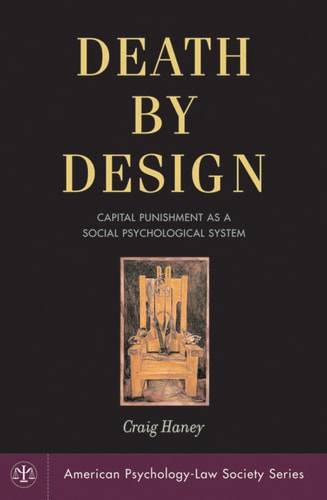
Death by Design: Capital Punishment As a Social Psychological System
0
0
As an Amazon Associate and affiliate partner, Menrva Books earns from qualifying purchases. Learn more
Author Description
How can otherwise normal, moral persons - as citizens, voters, and jurors - participate in a process that is designed to take the life of another? In DEATH BY DESIGN, research psychologist Craig Haney argues that capital punishment, and particularly the sequence of events that lead to death sentencing itself, is maintained through a complex and elaborate social psychological system that distances and disengages us from the true nature of the task. Relying heavily on his own research and that of other social scientists, Haney suggests that these social psychological forces enable persons to engage in behavior from which many of them otherwise would refrain. However, by facilitating death sentencing in these ways, this inter-related set of social psychological forces also undermines the reliability and authenticity of the process, and compromises the fairness of its outcomes. Because these social psychological forces are systemic in nature - built into the very system of death sentencing itself - Haney concludes by suggesting a number of inter-locking reforms, derived directly from empirical research on capital punishment, that are needed to increase the fairness and reliability of the process. The historic and ongoing public debate over the death penalty takes place not only in courtrooms, but also in classrooms, offices, and living rooms. This timely book offers stimulating insights into capital punishment for professionals and students working in psychology, law, criminology, sociology, and cultural area studies. As capital punishment receives continued attention in the media, it is also a necessary and provocative guide that empowers all readers to come to their own conclusions about the death penalty.
Menrva's Summary
THE THESIS
This book investigates the social psychological mechanisms that allow ordinary citizens and legal actors to participate in the capital punishment process. Author Craig Haney, a research psychologist, utilizes empirical data and social science research to argue that the death penalty system is sustained by psychological distancing and disengagement. He posits that these systemic forces enable behaviors that individuals might otherwise avoid, ultimately compromising the fairness and reliability of death sentencing outcomes.
THE SCOPE MAP
What You Will Find
- Analysis of the social psychological forces inherent in death sentencing
- Empirical research regarding juror and citizen decision-making
- Proposed inter-locking reforms to improve process reliability
- Examination of the systemic nature of capital punishment
Scope Limits
- Does not provide a comprehensive legal history of the death penalty
- Focuses primarily on psychological and social factors rather than purely philosophical or moral arguments
THE AUTHORITY PERSPECTIVE
Experts and academics in the fields of psychology and law frequently cite this work as a foundational text for understanding the human elements of the capital punishment system. Readers often note the academic density of the prose, which provides a rigorous, evidence-based critique suitable for professionals and students alike.
Page Count:
348
Publication Date:
2005-01-01
Publisher:
Oxford University Press
ISBN-10:
0190292946
ISBN-13:
9780190292942
Psychology
Social Science
Sociology
Criminology
Law
Community Tags
Similar Books