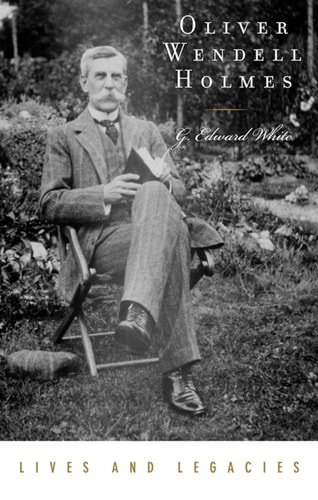
Oliver Wendell Holmes Jr. (Lives and Legacies Series)
0
0
As an Amazon Associate and affiliate partner, Menrva Books earns from qualifying purchases. Learn more
Author Description
Known as the "Great Dissenter," Oliver Wendell Holmes, Jr. wrote some of the most eloquent opinions in the history of the United States Supreme Court. A brilliant legal mind who served on the high court into his nineties, Holmes was responsible for some of the most important judicial opinions of the twentieth century. Now, in this superb short biography, G. Edward White offers readers a lively, informative portrait of this singular individual. The book first sketches Holmes's early years--his childhood in Boston, his undergraduate years at Harvard (which his father and both grandfathers also attended), and his valiant service in the Civil War, during which he was severely wounded three times. After the war, Holmes went into private law practice, wrote his landmark treatise The Common Law in 1881, had a short tenure on the Harvard Law School faculty, and spent 20 years as a judge on the Supreme Judicial Court of Massachusetts before being named to the U.S. Supreme Court. The author focuses on his remarkable 30-year service as a Supreme Court Justice, beginning in 1902, and details Holmes's most significant cases--Abrams v. United States, Northern Securities Co. v. United States, Lochner v. New York, Schenck v. United States, and others--which limited working hours, set a mandatory minimum wage, protected women's rights, legalized labor unions, and defined freedom of speech. These decisions--as well as The Common Law--are highly regarded to this day. A new volume in the Lives and Legacy series, this marvelous short biography offers an ideal introduction to a towering figure in American law.
Menrva's Summary
THE THESIS
This biography investigates the intellectual evolution and judicial legacy of Oliver Wendell Holmes Jr., examining how his experiences shaped his contributions to American jurisprudence. G. Edward White, a legal historian, utilizes primary source documents and historical context to trace Holmes's trajectory from a Civil War soldier to a long-serving Supreme Court Justice. The author argues that Holmes's skepticism and pragmatic approach to law fundamentally altered the interpretation of constitutional rights in the twentieth century.
THE SCOPE MAP
What You Will Find
- A chronological overview of Holmes's life from his Boston upbringing to his tenure on the Supreme Court.
- Analysis of landmark judicial opinions including Abrams v. United States and Lochner v. New York.
- Examination of his seminal legal text, The Common Law.
Scope Limits
- The text does not provide an exhaustive psychological profile of Holmes's personal life outside of his professional and public spheres.
- It does not offer a comprehensive history of the entire Supreme Court during the early twentieth century, focusing primarily on Holmes's specific influence.
THE AUTHORITY PERSPECTIVE
Experts recognize this work as a concise and accessible entry point for those seeking to understand the impact of Holmes on American legal thought. Readers frequently note that the prose balances academic rigor with a narrative style suitable for non-specialists interested in judicial history.
Page Count:
162
Publication Date:
2006-01-01
Publisher:
Oxford University Press
ISBN-10:
0190294086
ISBN-13:
9780190294083
History
Biography
Non-Fiction
Professional Career & Trade
English & College Success
Biography Autobiography
Judges biography
Legal History
United States
English
Law
Community Tags
Similar Books