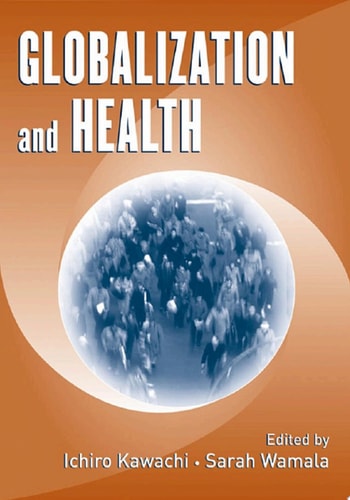
Globalization and Health
0
0
As an Amazon Associate and affiliate partner, Menrva Books earns from qualifying purchases. Learn more
Author Description
Globalization is breaking down economic, political, cultural, demographic, and social barriers across the world at an astonishing pace. The topic of globalization can arouse passionate debate in many circles including academic journals, the popular media, and even on the streets. This new world order is marked by new actors, new rules of governance, new forms of communication, and the global movement of populations. Health is an exquisitely sensitive mirror of social conditions, and the authors of this book argue that the assessment of health is an important criterion for evaluating and monitoring the progress of globalization.This book provides an analysis of the most serious global threats to health, the tools that can be used to evaluate them, and the international agencies established to respond to them. Medical threats such as infectious diseases, obesity, tobacco use, and global climate change are discussed, but the authors also expand their scope to include socio-political health impacts such as economic inequality. The complex role of organizations such as the World Health Organization, the International Monetary Fund, and the World Bank is also analyzed, as is the increasing interconnectedness of health and non-health actors. Is this blurring of boundaries really beneficial to the public's health, or have these actors abandoned health issues for power politics? By drawing together an international group of health experts,Globalization and Health provides a comprehensive account of the successes and failures, as well as the challenges and opportunities of globalization for public health.
Menrva's Summary
THE THESIS
This book investigates how the rapid acceleration of globalization impacts public health outcomes and whether international governance structures effectively address these challenges. Authors Ichiro Kawachi and Sarah Wamala, both established experts in social epidemiology and public health, argue that health serves as a critical indicator for measuring the success of global integration. They present a framework that evaluates the intersection of economic policy, social conditions, and medical outcomes to determine if global actors prioritize human well-being or political influence.
THE SCOPE MAP
What You Will Find
- Analysis of global health threats including infectious diseases, obesity, and tobacco use
- Examination of the roles played by the World Health Organization, the International Monetary Fund, and the World Bank
- Discussion on the socio-political impacts of economic inequality and climate change
Scope Limits
- Does not provide a comprehensive clinical guide for treating specific diseases
- Does not offer a definitive policy manual for individual national health systems
THE AUTHORITY PERSPECTIVE
Experts recognize this work as a foundational text for understanding the complex relationship between global economic structures and population health. Readers frequently note the academic density of the prose, which is well-suited for students and professionals in public health and international policy.
Page Count:
356
Publication Date:
2006-01-01
Publisher:
Oxford University Press
ISBN-10:
0190291575
ISBN-13:
9780190291570
Economics
English & College Success
Linguistics
International relations
English
Public Health
Medical
Allied Health
Sociology
Globalization
Community Tags
Similar Books