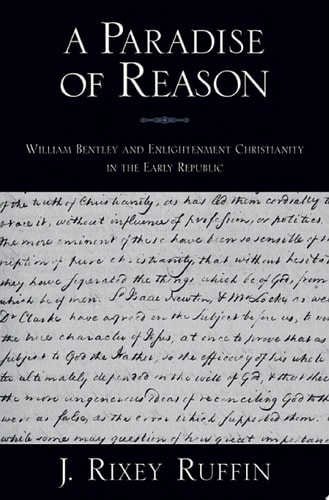
A Paradise of Reason: William Bentley and Enlightenment Christianity in the Early Republic
0
0
As an Amazon Associate and affiliate partner, Menrva Books earns from qualifying purchases. Learn more
Author Description
William Bentley, pastor in Salem, Massachusetts from 1783 to his death in 1819, was unlike anyone else in America's founding generation, for he had come to unique conclusions about how best to maintain a traditional understanding of Christianity in a world ever changing by the forces of the Enlightenment. Like some of his contemporaries, Bentley preached a liberal Christianity, with its benevolent God and salvation through moral living, but he-and in New England he alone-also preached a rational Christianity, one that offered new and radical claims about the power of God and the attributes of Jesus. Drawing on over a thousand of Bentley's sermons, J. Rixey Ruffin traces the evolution of Bentley's theology. Neither liberal nor deist, Bentley was instead what Ruffin calls a "Christian naturalist," a believer in the biblical God and in the essential Christian narrative but also in God's unwillingness to interfere in nature after the Resurrection. In adopting such a position, Bentley had pushed his faith as far as he could toward rationalism while still, he thought, calling it Christianity. But this book is as much a social and political history of Salem in the early republic as it is an intellectual biography; it not only delineates Bentley's ideas, but perhaps more important, it unravels their social and political consequences. Using Bentley's remarkable diary and a vast archive of newspaper accounts, tax records, and electoral returns, Ruffin brings to life the sailors, widows, captains and merchants who lived with Bentley in the eastern parish of Salem. A Paradise of Reason is a study of the intellectual and tangible effects of rational religion in mercantile Salem, of theology and philosophy but also of ideology: of the social politics of race and class and gender, the ecclesiastical politics of establishment and dissent, the ideological politics of republicanism and classical liberalism, and the party politics of Federalism and Democratic-Republicanism.
Menrva's Summary
THE THESIS
This work investigates how William Bentley, a Salem pastor, reconciled traditional Christian doctrine with the burgeoning rationalism of the Enlightenment in the early American Republic. Author J. Rixey Ruffin, a historian of American religion, utilizes Bentley's extensive personal diaries, sermon archives, and local public records to argue that Bentley developed a unique "Christian naturalist" theology. This framework posits that while God established the Christian narrative, He ceased direct intervention in the natural world following the Resurrection, thereby aligning faith with the scientific and rationalist currents of the era.
THE SCOPE MAP
What You Will Find
- An intellectual biography of William Bentley spanning his ministry from 1783 to 1819.
- Analysis of the intersection between theology and the social politics of race, class, and gender in Salem.
- Examination of the political landscape of the early Republic, specifically the tension between Federalism and Democratic-Republicanism.
- Use of primary source materials including over one thousand sermons, tax records, and electoral returns.
Scope Limits
- The study is geographically confined to the eastern parish of Salem, Massachusetts.
- The analysis does not attempt to provide a comprehensive history of Enlightenment Christianity across the entire United States.
THE AUTHORITY PERSPECTIVE
Scholars recognize this text as a significant contribution to the study of early American religious history and the specific intellectual climate of New England. Readers frequently note the academic density of the prose, which effectively bridges the gap between theological discourse and local social history.
Page Count:
276
Publication Date:
2007-01-01
Publisher:
Oxford University Press
ISBN-10:
0190296100
ISBN-13:
9780190296100
Biography
Religion
History
Republicanism
Intellectual History
American History
Christianity
Community Tags
Similar Books