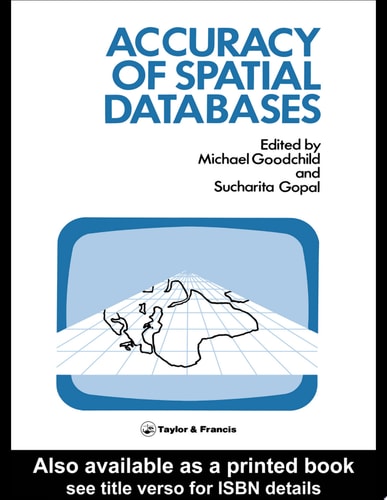
Accuracy of Spatial Databases
0
0
As an Amazon Associate and affiliate partner, Menrva Books earns from qualifying purchases. Learn more
Author Description
This book is the first collection of papers to address the problem of accuracy in spatial databases, and comprises papers drawn from a wide range of physical and human systems, taking approaches which vary from statistical to descriptive. Together they present both a comprehensive review of existing knowledge, techniques and experience, and an analysis of critical research needs in this area of spatial data handling. The papers selected in this book were originally presented in December 1988 in Montecito, California, at a meeting convened by the new US National Center for Geographic Information and Analysis (NCGIA), as the first of a series of initiatives to lay out a detailed agenda for activity in key problem areas in GIS.
Menrva's Summary
THE THESIS
This collection investigates the fundamental challenges of accuracy and error propagation within spatial databases and geographic information systems. The editors, Michael F. Goodchild and Sucharita Gopal, leverage their expertise in geographic information science to compile a series of papers that examine how data quality impacts spatial analysis. By synthesizing statistical and descriptive methodologies, the text establishes a framework for understanding the limitations of spatial data and identifies critical research trajectories for the field.
THE SCOPE MAP
What You Will Find
- Analysis of error propagation in geographic information systems
- Statistical methodologies for assessing spatial data quality
- Case studies covering both physical and human geographic systems
- Research agendas for future spatial data handling initiatives
THE AUTHORITY PERSPECTIVE
Experts recognize this work as a foundational text for the study of spatial data quality and GIS standards. Readers frequently note the academic density of the prose, which serves as a primary reference for researchers and practitioners in the field of geoinformatics.
Page Count:
308
Publication Date:
1989-01-01
Publisher:
Taylor & Francis Group
ISBN-10:
0203490231
ISBN-13:
9780203490235
Science
Technology
Cartography
Data Science
Geography
Community Tags
Similar Books