Marine Biofouling: Colonization Processes and Defenses
0
0
As an Amazon Associate and affiliate partner, Menrva Books earns from qualifying purchases. Learn more
Author Description
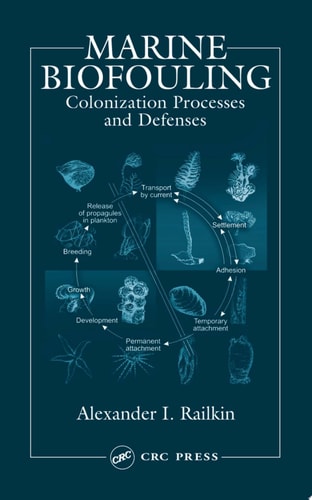
Recent instances of bioinvasion, such as the emergence of the zebra mussel in the American Great Lakes, generated a demand among marine biologists and ecologists for groundbreaking new references that detail how organisms colonize hard substrates, and how to prevent damaging biomass concentrations. Marine Biofouling: Colonization Processes and Defenses is the English language version of a comprehensive work by eminent Russian scientist Alexander I. Railkin, who details the causes of vast biomass concentrations on submerged hard substrates. He also delivers a quantitative description of colonization processes and provides detailed models for preventing biofouling. This volume expounds on many topics rarely discussed in the frame of one book: types of hard substrate communities; comparison of hard and soft substrate communities; harm caused by micro- and macrofoulers; larval taxes and drift; mechanisms of settlement and attachment of microorganisms, invertebrates, ascidians and macroalgae; the impact of currents; protection from epibionts; industrial biofouling protection; successions on hard substrates; and the recovery of disturbed communities or the self-assembly of communities. The text includes much Russian-language research translated for the first time. Through a thorough examination of substrate organisms and an exploration of preventive methods, this monograph prepares those concerned with marine biology to help protect the self-purifying organisms that keep marine ecosystems healthy and productive.
Menrva's Summary
THE THESIS
This monograph investigates the biological mechanisms of marine biofouling and the ecological processes governing the colonization of submerged hard substrates. Alexander I. Railkin, an eminent Russian scientist, synthesizes decades of research to provide a quantitative framework for understanding how microorganisms, invertebrates, and macroalgae attach to surfaces. By integrating previously untranslated Russian-language studies with broader ecological data, the author establishes a comprehensive model for both the development of biomass concentrations and the implementation of industrial prevention strategies.
THE SCOPE MAP
What You Will Find
- Quantitative models of larval taxes, drift, and settlement mechanisms for diverse marine organisms.
- Comparative analysis of hard versus soft substrate community structures and successional patterns.
- Technical evaluation of industrial biofouling protection methods and ecological impact mitigation.
- Detailed examination of micro
- and macrofouler interactions within marine ecosystems.
THE AUTHORITY PERSPECTIVE
Experts recognize this volume as a significant contribution to the field, particularly for its inclusion of specialized Russian research that was previously inaccessible to the global scientific community. Readers frequently note the academic density of the prose, which serves as a foundational reference for marine biologists and ecologists addressing bioinvasion and industrial fouling issues.
Page Count:
320
Publication Date:
2003-01-01
Publisher:
Taylor & Francis, Inc.
ISBN-10:
0203503236
ISBN-13:
9780203503232
Science
Oceanography
Marine Biology
Ecology