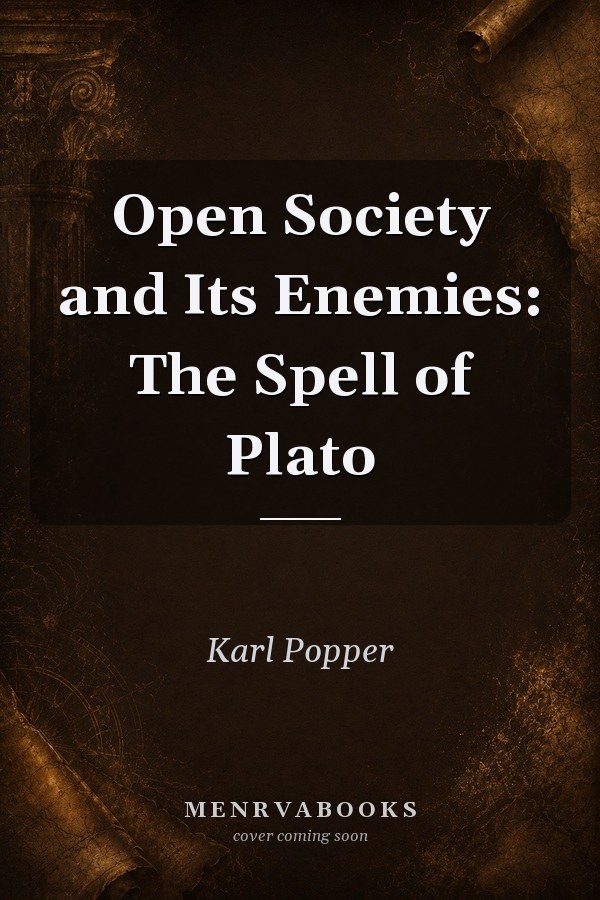
Open Society and Its Enemies: The Spell of Plato
0
0
As an Amazon Associate and affiliate partner, Menrva Books earns from qualifying purchases. Learn more
Author Description
An open society provides its citizens with a mechanism for changing government; a closed society doesn't, forcing its citizens to rely on extra-legal revolution. Popper analyzes the open-closed society debate using three exemplars of closed-society advocacy: Plato, Hegel (and wow, does Popper hate on Hegel), and Marx. The main analytical viewpoints are historicist (backward-looking, utopian) motivations for closed societies and rational (forward-looking, empirical) motivations for open societies.
Menrva's Summary
THE THESIS
Karl Popper investigates the fundamental tension between open societies that allow for democratic reform and closed societies that rely on authoritarian control. Popper, a philosopher of science and social theorist, utilizes this work to critique the intellectual foundations of totalitarianism. He argues that historicism—the belief that history follows inevitable laws—serves as the primary justification for closed systems, contrasting this with the rational, empirical approach required for a functioning open society.
THE SCOPE MAP
What You Will Find
- A detailed critique of Plato's political philosophy as a blueprint for totalitarianism.
- An analysis of the historicist fallacies inherent in the works of Hegel and Marx.
- A defense of liberal democracy and the necessity of incremental social engineering.
- A clear distinction between the closed society, characterized by tribalism, and the open society, defined by individual critical thought.
THE AUTHORITY PERSPECTIVE
Experts frequently cite this work as a foundational text in 20th-century political philosophy, particularly for its rigorous defense of democratic institutions. Readers often note the academic density of the prose and the author's uncompromising stance against historicist ideologies.
Page Count:
432
Publication Date:
2014-01-01
Publisher:
Taylor & Francis Group
ISBN-10:
0203538110
ISBN-13:
9780203538111
History
Philosophy
Political Philosophy
Social change
Social Theory
Liberty
Community Tags
Similar Books