Practical Necessity, Freedom, and History: From Hobbes to Marx
0
0
As an Amazon Associate and affiliate partner, Menrva Books earns from qualifying purchases. Learn more
Author Description
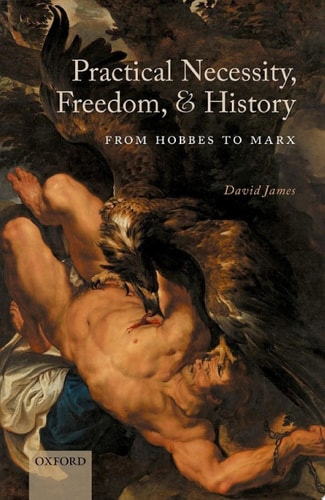
By means of careful analysis of relevant writings by Hobbes, Rousseau, Kant, Hegel, and Marx, David James argues that the concept of practical necessity is key to understanding the nature and extent of human freedom. Practical necessity means being, or believing oneself to be, constrained to perform certain actions in the absence (whether real or imagined) of other, more attractive options, or by the high costs involved in pursuing other options. Agents become subject to practical necessity as a result of economic, social, and historical forces over which they have, or appear to have, no effective control, and the extent to which they are subject to it varies according to the amount of economic and social power that one agent possesses relative to other agents. The concept of practical necessity is also shown to take into account how the beliefs and attitudes of social agents are in large part determined by social and historical processes in which they are caught up, and that the type of motivation that we attribute to agents must recognize this. Practical Necessity, Freedom, and History: From Hobbes to Marx shows how Rousseau, Kant, Hegel, and Marx, in contrast to Hobbes, explain the emergence of the conditions of a free society in terms of a historical process that is initially governed by practical necessity. The role that this form of necessity plays in explaining history necessity invites the following question: to what extent are historical agents genuinely subject to both practical and historical necessity?
Menrva's Summary
THE THESIS
How does the concept of practical necessity define the boundaries of human freedom within historical and social frameworks? David James, a scholar of modern philosophy, examines the works of Hobbes, Rousseau, Kant, Hegel, and Marx to argue that practical necessity—the constraint of action due to limited options or high costs—is central to understanding agency. He posits that economic and social power dynamics dictate the extent to which individuals are subject to these forces, suggesting that freedom is not an abstract state but a condition emerging from historical processes.
THE SCOPE MAP
What You Will Find
- Comparative analysis of political philosophy from the 17th to the 19th century.
- A framework for evaluating how social and economic power influences individual motivation.
- Examination of the transition from Hobbesian individualism to the historical materialism of Marx.
Scope Limits
- The text does not provide a contemporary policy guide or modern economic manual.
- It does not cover non-Western philosophical traditions or post-Marxist political theory.
THE AUTHORITY PERSPECTIVE
Scholars identify this work as a rigorous contribution to the history of political thought, noting its dense analytical approach to canonical texts. It is frequently cited for its clear synthesis of how historical necessity shapes the development of modern concepts of freedom.
Page Count:
242
Publication Date:
2021-01-01
Publisher:
OUP Oxford
ISBN-10:
0192587110
ISBN-13:
9780192587114
Philosophy
Philosophy history
Political Philosophy
Liberty
Social Theory
Necessity Philosophy
Community Tags
Similar Books