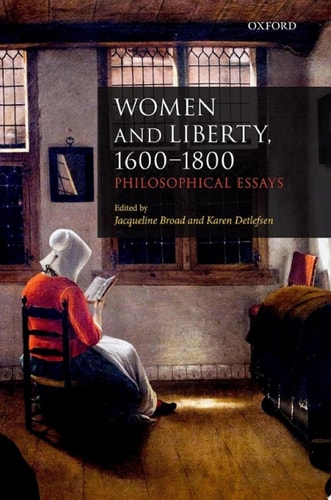
Women and Liberty, 1600-1800: Philosophical Essays
0
0
As an Amazon Associate and affiliate partner, Menrva Books earns from qualifying purchases. Learn more
Author Description
There have been many different historical-intellectual accounts of the shaping and development of concepts of liberty in pre-Enlightenment Europe. This volume is unique for addressing the subject of liberty principally as it is discussed in the writings of women philosophers, and as it is theorized with respect to women and their lives, during this period. The volume covers ethical, political, metaphysical, and religious notions of liberty, with some chapters discussing women's ideas about the metaphysics of free will, and others examining the topic of women's freedom (or lack thereof) in their moral and personal lives as well as in the public socio-political domain. In some cases, these topics are situated in relation to the emergence of the concept of autonomy in the late eighteenth century, and in others, with respect to recent feminist theorizing about relational autonomy and internalized oppression. Many of the chapters draw upon a wide range of genres, including polemical texts, poetry, plays, and other forms of fiction, as well as standard philosophical treatises. Taken as a whole, this volume shows how crucial it is to recover the too-long forgotten views of female and women-friendly male philosophers of the seventeenth and eighteenth centuries. In the process of recovering these voices, our understanding of philosophy in the early modern period is not only expanded, but also significantly enhanced, toward a more accurate and gender-inclusive history of our discipline.
Menrva's Summary
THE THESIS
This volume investigates how concepts of liberty were theorized, debated, and shaped by women philosophers in Europe between 1600 and 1800. Editors Jacqueline Broad and Karen Detlefsen curate a collection of essays that challenge traditional, male-centric historical accounts of early modern philosophy. By examining diverse texts ranging from formal treatises to poetry and plays, the contributors argue that women's intellectual contributions are vital to a comprehensive understanding of autonomy, free will, and socio-political freedom in the pre-Enlightenment era.
THE SCOPE MAP
What You Will Find
- Analysis of ethical, metaphysical, and religious frameworks of liberty.
- Examination of women's agency within personal, moral, and public domains.
- Comparative studies between early modern texts and contemporary feminist theories of relational autonomy.
- Diverse source material including polemical writing, drama, and philosophical prose.
Scope Limits
- The volume focuses specifically on the seventeenth and eighteenth centuries in Europe.
- It does not provide an exhaustive survey of all female philosophers, but rather highlights specific case studies and thematic intersections.
THE AUTHORITY PERSPECTIVE
Scholars and historians of philosophy recognize this collection as a significant contribution to the ongoing project of recovering marginalized voices in early modern intellectual history. Readers frequently note the academic density of the prose, which serves as a rigorous resource for students and researchers interested in gender-inclusive philosophical inquiry.
Page Count:
272
Publication Date:
2017-01-01
Publisher:
OUP Oxford
ISBN-10:
0192538233
ISBN-13:
9780192538239
Philosophy
Liberty
Early Modern
History & Surveys
Womens Studies
Political Philosophy
Philosophy history
Feminist Philosophy
Community Tags
Similar Books