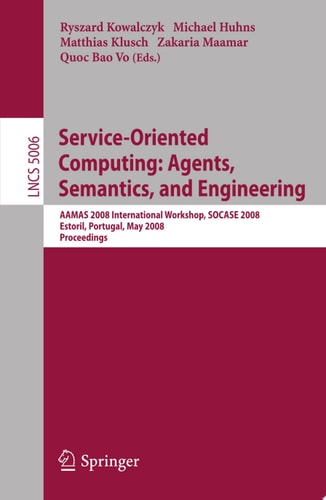
Service-Oriented Computing: Agents, Semantics, and Engineering
0
0
As an Amazon Associate and affiliate partner, Menrva Books earns from qualifying purchases. Learn more
Author Description
The global trend towards more flexible and dynamic business process integration and automation has led to a convergence of interests between service-oriented computing, semantic technology, and intelligent multi-agent systems. In particular, the areas of service-oriented computing and semantic technology offer much interest to the multi-agent system community, including similarities in system architectures and provision processes, powerful tools, and the focus on issues such as quality of service, security, and reliability. Similarly, techniques developed in the multi-agent systems and semantic technology promise to have a strong impact on the fast-growing service-oriented computing technology. Service-oriented computing has emerged as an established paradigm for distributed computing and e-business processing. It utilizes services as fundamental building blocks to enable the development of agile networks of collaborating business applications distributed within and across organizational boundaries. Services are self-contained, platform-independent software components that can be described, published, discovered, orchestrated, and deployed for the purpose of developing distributed applications across large heterogeneous networks such as the Internet. Multi-agent systems are also aimed at the development of distributed applications, however, from a different but complementary perspective. Service-oriented paradigms are mainly focused on syntactical and declarative definitions of software components, their interfaces, communication channels, and capabilities with the aim of creating interoperable and reliable infrastructures. In contrast, multi-agent systems center on the development of reasoning and planning capabilities of autonomous problem solvers that apply behavioral concepts such as interaction, collaboration, or negotiation in order to create flexible and fault-tolerant distributed systems for dynamic and uncertain environments.
Menrva's Summary
THE THESIS
This book explores the convergence of service-oriented computing, semantic technology, and intelligent multi-agent systems. It details how these fields offer complementary perspectives on distributed computing, with service-oriented computing focusing on system architectures and quality of service, while multi-agent systems emphasize reasoning and autonomous problem-solving in dynamic environments. The proceedings investigate the impact of multi-agent systems and semantic technology on the growing field of service-oriented computing, examining their potential to enhance business process integration and automation.
THE SCOPE MAP
- Research papers from the AAMAS 2008 International Workshop on Service-Oriented Computing: Agents, Semantics, and Engineering (SOCASE 2008).
- Discussions on the integration of service-oriented computing (SOC) with semantic technologies.
- Exploration of the synergies between SOC and multi-agent systems (MAS).
- Analysis of challenges and opportunities in developing agile networks of collaborating business applications.
- Examination of concepts such as quality of service, security, and reliability in distributed systems.
- Insights into the reasoning and planning capabilities of autonomous agents.
- Case studies and theoretical frameworks for e-business processing and distributed application development.
THE AUTHORITY PERSPECTIVE
This collection of proceedings from the SOCASE 2008 workshop presents research at the intersection of several key areas in computer science. The papers likely offer in-depth technical analyses and propose novel approaches to integrating service-oriented architectures with semantic web technologies and multi-agent systems. The focus on practical applications in business process integration and automation suggests a readership of researchers and practitioners in distributed systems and artificial intelligence.
Page Count:
149
Publication Date:
2008-05-01
Publisher:
Springer
ISBN-10:
3540799680
ISBN-13:
9783540799689
Science & Technology
Non-Fiction
E-business
Distributed Computing
Computer Science
Community Tags
Similar Books


Reader Comments
Share Your Thoughts
No comments yet. Be the first to share your thoughts!