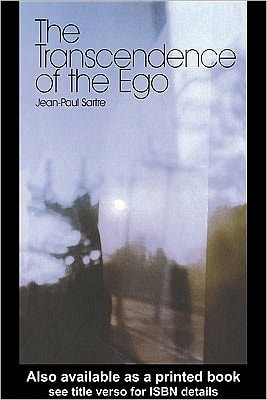
Transcendence of the Ego: A Sketch for a Phenomenological Description
0
0
As an Amazon Associate and affiliate partner, Menrva Books earns from qualifying purchases. Learn more
Author Description
First published in France in 1936 as a journal article, The Transcendence of the Ego was one of Jean-Paul Sartre's earliest philosophical publications. When it appeared, Sartre was still largely unknown, working as a school teacher in provincial France and struggling to find a publisher for his most famous fictional work, Nausea. The Transcendence of the Ego is the outcome of Sartre's intense engagement with the philosophy of Edmund Husserl, the founder of phenomenology. Here, as in many subsequent writings, Sartre embraces Husserl's vision of phenomenology as the proper method for philosophy. But he argues that Husserl's conception of the self as an inner entity, 'behind' conscious experience is mistaken and phenomenologically unfounded. The Transcendence of the Ego offers a brilliant diagnosis of where Husserl went wrong, and a radical alternative account of the self as a product of consciousness, situated in the world. This essay introduces many of the themes central to Sartre's major work, Being and Nothingness: the nature of consciousness, the problem of self-knowledge, other minds, anguish. It demonstrates their presence and importance in Sartre's thinking from the very outset of his career. This fresh translation makes this classic work available again to students of Sartre, phenomenology, existentialism, and twentieth century philosophy. It includes a thorough and illuminating introduction by Sarah Richmond, placing Sartre's essay in its philosophical and historical context.
Menrva's Summary
THE THESIS
Does the self exist as an internal entity behind conscious experience, or is it a product of consciousness itself? Jean-Paul Sartre, a foundational figure in existentialist thought, utilizes this early essay to critique the phenomenological framework established by Edmund Husserl. By challenging the notion of an 'ego' residing within the mind, Sartre argues that consciousness is inherently directed outward toward the world, positioning the self as an object constructed through experience rather than a pre-existing subject.
THE SCOPE MAP
What You Will Find
- A critical analysis of Husserlian phenomenology and the concept of the transcendental ego.
- A philosophical argument regarding the nature of consciousness and self-knowledge.
- An examination of the relationship between the subject and the external world.
- Foundational concepts that later informed Sartre's major work, Being and Nothingness.
THE AUTHORITY PERSPECTIVE
Scholars and students of twentieth-century philosophy frequently cite this text as a vital entry point for understanding the evolution of Sartre's existentialist project. Experts highlight the work as a foundational document that clarifies the divergence between Sartre's developing thought and the traditional phenomenological school of the time.
Page Count:
63
Publication Date:
2004-01-01
Publisher:
Taylor & Francis Group
ISBN-10:
0203694368
ISBN-13:
9780203694367
Philosophy
Non-Fiction
Existentialism
Phenomenology
Community Tags
Other Editions(3)


Similar Books