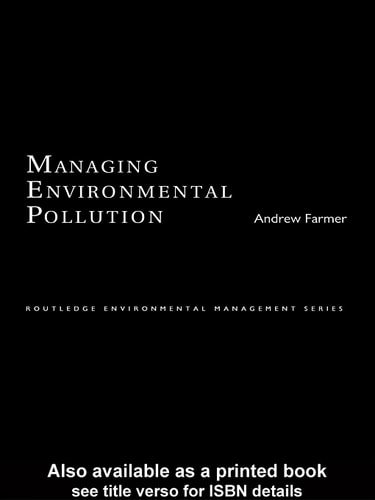
Managing Environmental Pollution
0
0
As an Amazon Associate and affiliate partner, Menrva Books earns from qualifying purchases. Learn more
Author Description
Managing Environmental Pollution presents a comprehensive introduction to the nature of pollution, its impacts on the environment, and the practical options and regulatory frameworks for pollution control. Sources of pollution, regulatory controls - including the role of authorities and precautionary and polluter pays principles - technological solutions, management and mitigation techniques and assessment tools, are examined in each key area: air, freshwater, and marine pollution, contaminated land and radioactive substances. Illustrated with a wide range of global case studies this book offers an invaluable up-to-date guide to both the principles and practice of pollution management.
Menrva's Summary
THE THESIS
This text investigates the fundamental mechanisms of environmental pollution and the regulatory frameworks required to mitigate its impact on global ecosystems. Andrew M. Farmer provides a structured analysis of pollution sources, drawing upon established environmental principles such as the precautionary principle and the polluter pays model. The book synthesizes technical management techniques with policy-driven assessment tools to offer a comprehensive overview of current environmental governance. By examining diverse sectors including air, water, and land, the author establishes a logical framework for understanding how authorities manage and control industrial and environmental hazards.
THE SCOPE MAP
What You Will Find
- Analysis of air, freshwater, and marine pollution dynamics.
- Examination of regulatory controls and legislative frameworks for pollution management.
- Application of the precautionary principle and polluter pays principle in environmental policy.
- Technical mitigation techniques and assessment tools for contaminated land and radioactive substances.
- Global case studies illustrating practical pollution control applications.
THE AUTHORITY PERSPECTIVE
Experts recognize this work as a foundational text for students and professionals seeking a broad introduction to environmental management. Readers frequently note the clarity of the prose and the utility of the global case studies in bridging the gap between theoretical policy and practical application.
Page Count:
0
Publication Date:
2004-01-01
Publisher:
Taylor & Francis Group Plc
ISBN-10:
0203748352
ISBN-13:
9780203748350
Nonfiction
Pollution Control
Sustainability
Pollution
Ecology
Community Tags
Similar Books