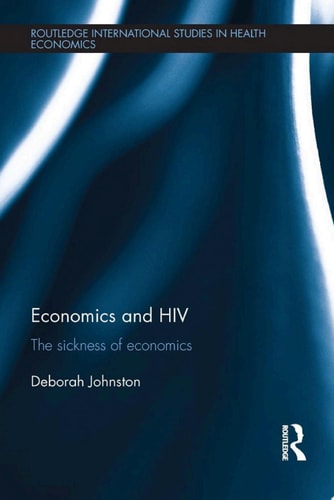
Economics and HIV
0
0
As an Amazon Associate and affiliate partner, Menrva Books earns from qualifying purchases. Learn more
Author Description
This book explains how, and why, economics has been applied to a terrible pandemic, using a range of examples mostly drawn from the region most affected, Sub-Saharan Africa. Part I shows that microeconomic approaches have found fertile ground in a public health approach that 'blames' individual choices for HIV transmission. Despite their attractiveness, however, these approaches fail to explain contemporary patterns of HIV prevalence, illustrating the importance of factors that are excluded from the standard micro-economic approach. Part II of the book looks at our problems in understanding.
Menrva's Summary
THE THESIS
This book investigates the efficacy and limitations of applying standard microeconomic frameworks to the analysis of the HIV pandemic, particularly within Sub-Saharan Africa. Deborah Johnston, an expert in development economics, evaluates how individual-choice models have dominated public health policy and argues that these approaches frequently overlook structural and systemic factors. By contrasting theoretical economic models with observed epidemiological patterns, the author demonstrates the necessity of a more comprehensive analytical approach to understanding the spread and impact of the virus.
THE SCOPE MAP
What You Will Find
- Analysis of microeconomic theories applied to individual behavior and HIV transmission.
- Evaluation of economic impacts of AIDS across past, present, and future timelines.
- Case studies and data primarily focused on the Sub-Saharan African region.
- Critique of current economic fashions and fads in public health policy.
THE AUTHORITY PERSPECTIVE
Experts recognize this text as a critical contribution to the intersection of health policy and development economics. Readers frequently note the academic density of the prose, which serves as a foundational critique for students and practitioners evaluating the limitations of standard economic modeling in public health crises.
Page Count:
0
Publication Date:
2013-01-01
Publisher:
Taylor & Francis Group
ISBN-10:
0203768701
ISBN-13:
9780203768709
Economics
Hiv Infections
Social Science
AIDS Disease
Epidemiology
Public Health