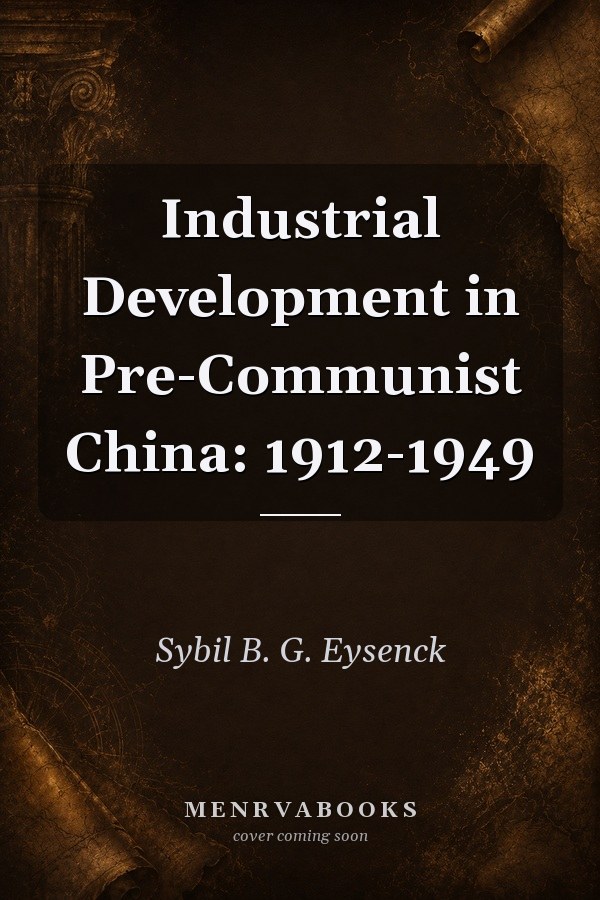
Industrial Development in Pre-Communist China: 1912-1949
0
0
As an Amazon Associate and affiliate partner, Menrva Books earns from qualifying purchases. Learn more
Author Description
The Chinese economy has been the subject of substantial research in recent years in the United States and abroad. Much has been made of significant strides toward industrial development since the Communist takeover. But it is impossible to understand what has been achieved unless one measures these gains against economic events in the pre-Communist period. This book offers a record of China's industrialization, with its comprehensive statistical analysis of the industrial growth of pre-Communist China.Industrial Development in Pre-Communist China covers the period from 1912 to 1949 and deals with all of China irrespective of changes in political boundaries. For purposes of this study, "industrial production" includes mining, metallurgy, manufacturing, and fuel and power; the construction industry is not included. Chang finds that the average annual rate of growth of the modern industrial sector during the pre-World War I period was about 8 or 9 percent, including Manchuria. During the period from 1928 to 1936, under the Nanking Government, political unification was achieved. Peace and order were maintained and the necessary foundations for economic transformation in the post-World War II period were established.At the time of its original publication in 1969, Chang's work represented an important first step toward a comprehensive, quantitative study of the history of China's industrialization and a benchmark against which the Communist achievement can be measured, this work forces reconsideration of widely held views on China's economic and industrial development. An important reference for the study of Chinese history and economics, especially for the Republican period, Chang's work is of continuing value to all Sinologists and to specialists in economic development and economic history.
Menrva's Summary
THE THESIS
This work investigates the quantitative reality of China's industrial growth between 1912 and 1949 to provide a necessary baseline for evaluating post-Communist economic performance. The author, Sybil B. G. Eysenck, utilizes extensive statistical analysis to reconstruct the industrial output of the Republican period. By examining sectors such as mining, metallurgy, and power, the study challenges prevailing narratives regarding the stagnation of the Chinese economy prior to 1949. The framework establishes that significant foundational growth occurred under the Nanking Government, contradicting the assumption that industrialization began only after the Communist takeover.
THE SCOPE MAP
What You Will Find
- Comprehensive statistical data on industrial growth rates from 1912 to 1949.
- A defined scope of industrial production excluding the construction industry.
- Comparative analysis of growth during the pre-World War I era and the Nanking Government period.
- An examination of the role of Manchuria in the broader context of Chinese industrial development.
THE AUTHORITY PERSPECTIVE
Experts recognize this text as a foundational quantitative study for the Republican period of Chinese history. Scholars frequently cite the work for its rigorous statistical methodology and its enduring value as a benchmark for economic historians.
Page Count:
0
Publication Date:
2017-01-01
Publisher:
Taylor & Francis Group
ISBN-10:
0203788656
ISBN-13:
9780203788653
History
Economics
China
Asian Studies
Community Tags
Similar Books