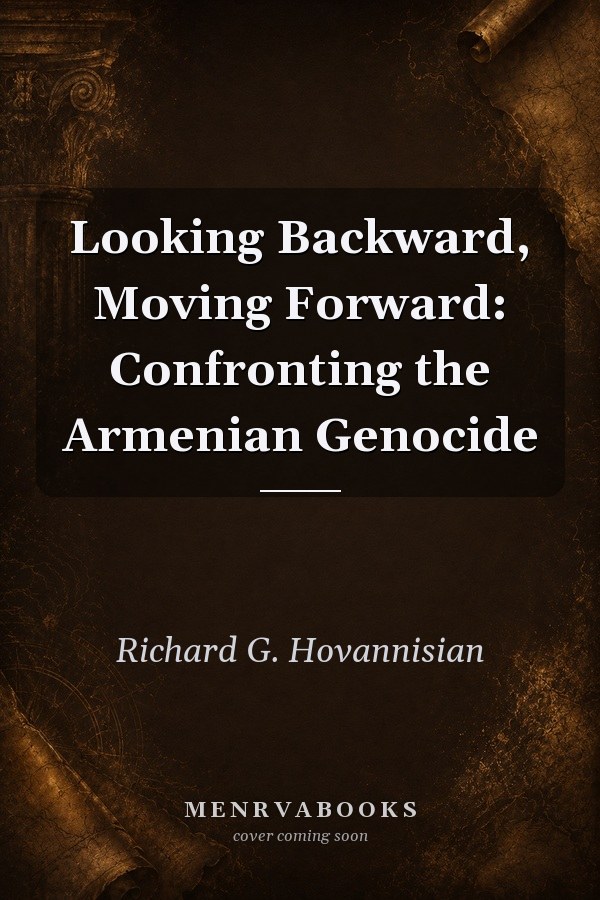
Looking Backward, Moving Forward: Confronting the Armenian Genocide
0
0
As an Amazon Associate and affiliate partner, Menrva Books earns from qualifying purchases. Learn more
Author Description
The Decades Separating Our New Century From The Armenian Genocide, The Prototype Of Modern-day Nation-killings, Have Fundamentally Changed The Political Composition Of The Region. Virtually No Armenians Remain On Their Historic Territories In What Is Today Eastern Turkey. The Armenian People Have Been Scattered About The World. And A Small Independent Republic Has Come To Replace The Armenian Soviet Socialist Republic, Which Was All That Was Left Of The Homeland As The Result Of Turkish Invasion And Bolshevik Collusion In 1920. One Element Has Remained Constant. Notwithstanding The Eloquent, Compelling Evidence Housed In The United States National Archives And Repositories Around The World, Successive Turkish Governments Have Denied That The Predecessor Young Turk Regime Committed Genocide, And, Like The Nazis Who Followed Their Example, Sought Aggressively To Deflect Blame By Accusing The Victims Themselves.this Volume Argues That The Time Has Come For Turkey To Reassess The Propriety Of Its Approach, And To Begin The Process That Will Allow It Move Into A Post-genocide Era. The Work Includes Genocide: An Agenda For Action, Gijs M. De Vries; Determinants Of The Armenian Genocide, Donald Bloxham; Looking Backward And Forward, Joyce Apsel; The United States Response To The Armenian Genocide, Simon Payaslian; The League Of Nations And The Reclamation Of Armenian Genocide Survivors, Vahram L. Shemmassian; Raphael Lemkin And The Armenian Genocide, Steven L. Jacobs; Reconstructing Turkish Historiography Of The Armenian Massacres And Deaths Of 1915, Fatma Muge Go;cek; Bitter-sweet Memories; The Armenian Genocide And International Law, Joe Verhoeven; New Directions In Literary Response To The Armenian Genocide, Rubina Peroomian; Denial And Free Speech, Henry C. Theriault; Healing And Reconciliation, Ervin Staub; State And Nation, Raffi K. Hovannisian.--provided By Publisher.
Menrva's Summary
THE THESIS
This volume investigates the enduring political and historical consequences of the Armenian Genocide and argues for a necessary shift in Turkish state policy toward acknowledgment and reconciliation. Richard G. Hovannisian, a preeminent scholar in Armenian history, compiles a series of essays from diverse experts to examine the mechanisms of genocide denial and the long-term impact on the Armenian diaspora. The work utilizes archival evidence, legal analysis, and historiographical critique to challenge the official Turkish narrative and propose a framework for moving into a post-genocide era.
THE SCOPE MAP
What You Will Find
- Historical analysis of the 1915 massacres and the subsequent geopolitical shifts in Eastern Turkey.
- Examination of international law and the role of global institutions like the League of Nations in the aftermath of the genocide.
- Case studies on the evolution of Turkish historiography and the persistent state-sponsored denial of the events.
- Theoretical frameworks for healing, reconciliation, and the intersection of free speech with historical memory.
THE AUTHORITY PERSPECTIVE
Scholars and historians recognize this collection as a significant contribution to the field of genocide studies, particularly for its multidisciplinary approach to the Armenian experience. Readers frequently note the academic density of the prose and the rigorous documentation provided by the contributing experts.
Page Count:
301
Publication Date:
2017-01-01
Publisher:
Taylor & Francis Group
ISBN-10:
0203786998
ISBN-13:
9780203786994
History
Human rights
Turkey history
Armenian History
Genocide
Armenia republic history
International relations
Community Tags
Similar Books