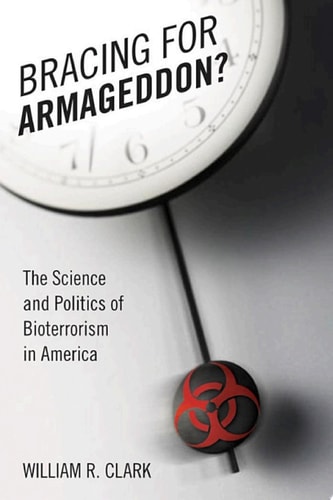
Bracing for Armageddon?: The Science and Politics of Bioterrorism in America
0
0
As an Amazon Associate and affiliate partner, Menrva Books earns from qualifying purchases. Learn more
Author Description
Since September 11th, the threat of a bioterrorist attack--massive, lethal, and unpreventable--has hung in the air over America. Bracing for Armageddon? offers a vividly written primer for the general reader, shedding light on the science behind potential bioterrorist attacks and revealing what could happen, what is likely to happen, and what almost certainly will not happen. The story opens with a riveting account of a bioterrorism scenario commissioned by the U.S. government. Using this doomsday tableau as a springboard, Clark reviews a host of bioterrorist threats (from agroterrorism to a poisoning of the water supply) and examines not only the worst-case menace of genetically engineered pathogens, but also the lethal agents on the CDC's official bioterrorism list, including Smallpox, Anthrax, Plague, Botulism, and Ebola. His overview of attempted bioterrorist attacks to date--such as the failed Aum Shinrikyo attempts in 1995 in Japan and the Anthrax attack in the US following 9/11--bolstered by interviews with a range of experts--shows why virtually all of these attempts have failed. Indeed, he demonstrates that a successful bioterrorism attack is exceedingly unlikely, while a major flu epidemic (such as the deadly epidemic of 1918 that killed millions worldwide) is a virtual certainty. Given the long odds of a bioterrorist attack, Clark asks, has the more than $40 billion the United States has dedicated to the defense against bioterrorism really been well spent? Is it time to move on to other priorities? In contrast to the alarmist fears stoked by the popular media, William Clark here provides a reassuring overview of what we really need to worry about--and what we don't.
Menrva's Summary
THE THESIS
This book investigates the discrepancy between the perceived threat of bioterrorism in the United States and the actual scientific and logistical probability of such attacks occurring. William R. Clark, a professor of immunology, utilizes his expertise in biological sciences to evaluate the feasibility of various pathogen-based threats. He argues that while public anxiety remains high, the historical record and scientific constraints suggest that the massive financial investment in bioterrorism defense may be disproportionate to the actual risk compared to natural pandemic threats.
THE SCOPE MAP
What You Will Find
- Analysis of CDC-listed pathogens including Smallpox, Anthrax, Plague, Botulism, and Ebola.
- Historical review of past bioterrorism attempts, such as the Aum Shinrikyo incidents and the 2001 US anthrax attacks.
- Comparative risk assessment between man-made biological threats and natural flu epidemics.
- Evaluation of US government spending on biodefense infrastructure.
Scope Limits
- The text does not provide a comprehensive manual for emergency response or personal survival tactics.
- It does not cover classified military intelligence or specific tactical details of current government defense protocols.
THE AUTHORITY PERSPECTIVE
Experts and reviewers characterize this work as a balanced, science-based counterpoint to alarmist media narratives regarding biological warfare. Readers frequently note that the prose is accessible to a general audience while maintaining the rigor expected of an academic perspective on public policy.
Page Count:
223
Publication Date:
2008-01-01
Publisher:
Oxford University Press
ISBN-10:
0190450622
ISBN-13:
9780190450625
Non-Fiction
National security
Public Health
Earth Sciences
Allied Health
United States
Epidemiology
Bioterrorism
Medical
Community Tags
Similar Books