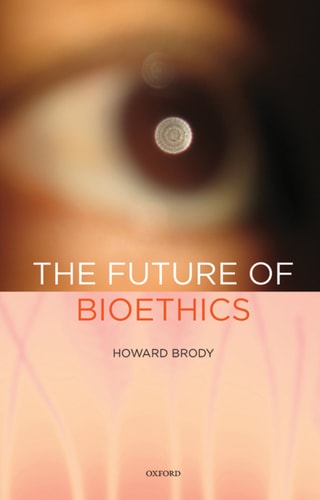
The Future of Bioethics
0
0
As an Amazon Associate and affiliate partner, Menrva Books earns from qualifying purchases. Learn more
Author Description
Bioethics, born in the 1960s and 1970s, has achieved great success, but also has experienced recent growing pains, as illustrated by the case of Terri Schiavo. In The Future of Bioethics, Howard Brody, a physician and scholar who dates his entry into the field in 1972, sifts through the various issues that bioethics is now addressing--and some that it is largely ignoring--to chart a course for the future. Traditional bioethical concerns such as medical care at the end of life and research on human subjects will continue to demand attention. Brody chooses to focus instead on less obvious issues that will promise to stimulate new ways of thinking. He argues for a bioethics grounded in interdisciplinary medical humanities, including literature, history, religion, and the social sciences. Drawing on his previous work, Brody argues that most of the issues concerned involve power disparities. Bioethics' response ought to combine new concepts that take power relationships seriously, with new practical activities that give those now lacking power a greater voice. A chapter on community dialogue outlines a role for the general public in bioethics deliberations. Lessons about power initially learned from feminist bioethics need to be expanded into new areas--cross cultural, racial and ethnic, and global and environmental issues, as well as the concerns of persons with disabilities. Bioethics has neglected important ethical controversies that are most often discussed in primary care, such as patient-centered care, evidence-based medicine, and pay-for-performance. Brody concludes by considering the tension between bioethics as contemplative scholarship and bioethics as activism. He urges a more activist approach, insisting that activism need not cause a premature end to ongoing conversations among bioethicists defending widely divergent views and thcories.
Menrva's Summary
THE THESIS
How can the field of bioethics evolve to address power imbalances and incorporate broader interdisciplinary perspectives to remain relevant in the modern medical landscape? Howard Brody, a physician and scholar with decades of experience in the field, examines the current limitations of bioethics. He argues that the discipline must shift its focus from traditional end-of-life and research concerns toward systemic power disparities. By integrating medical humanities and social sciences, Brody proposes a framework that prioritizes activism and community engagement to give a voice to marginalized populations.
THE SCOPE MAP
What You Will Find
- Analysis of power dynamics in clinical and research settings
- Frameworks for integrating literature, history, and social sciences into ethical deliberation
- Strategies for community dialogue and public participation in bioethical policy
- Critique of neglected primary care issues like evidence-based medicine and pay-for-performance
Scope Limits
- Does not provide a comprehensive history of the field's origins
- Does not offer specific legal advice or clinical protocols for individual medical cases
THE AUTHORITY PERSPECTIVE
Experts recognize this work as a significant contribution to the evolution of bioethical theory, particularly regarding the intersection of clinical practice and social justice. Readers frequently note the author's balanced approach in navigating the tension between academic scholarship and practical activism.
Page Count:
272
Publication Date:
2009-01-01
Publisher:
Oxford University Press
ISBN-10:
0190452161
ISBN-13:
9780190452162
Philosophy
Bioethics
Public Health
Allied Health
Medical
Medical Ethics
Sociology