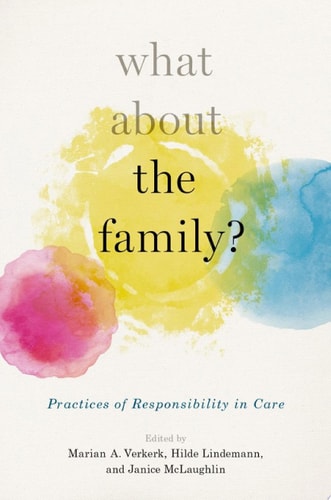
What About the Family?: Practices of Responsibility in Care
0
0
As an Amazon Associate and affiliate partner, Menrva Books earns from qualifying purchases. Learn more
Author Description
Health and social care decisions, and how they impact a family, are often viewed from the perspective of the individual family member making them--for example, the role of the parent in surrogacy questions, the care of the elderly, or decisionis that involve fetuses or organ donations. This volume represents a concerted, collaborative effort to depart from this practice--it shows, rather, that the family unit as a whole shapes and influences the patient's decisions and very understanding of the choice at hand. The family is intrinsic and inseparable from such ethical choices. This deeper level of thinking about families and health care poses an entirely new set of difficult questions. Which family members are relevant in influencing a patient, and why is this so? What is a family, in the first place? What duties does a family have to its own members?This volume, edited by bioethicists Hilde Lindemann, Marian Verkerk, and Janice McLaughlin, develops an ethic radically distinct from health care ethics, feminist ethics, or an ethic of care, even though authors draw on many of the resources those approaches offer. What makes an ethics of families distinctive is that it theorizes relationships characterized by ongoing intimacy and partiality among people who are not interchangeable, and remains centered on the practices of responsibility arising from these relationships.What About the Family? represents an interdisciplinary effort, drawing, among other resources, on its authors' backgrounds in sociology, nursing, philosophy, bioethics, and the medical sciences. Contributors begin from the assumption that any ethical examination of the significance of family ties to health and social care will benefit from a dialogue with the debates about family occuring in these other disciplinary areas, and examine why families matter, how families are recognized, how families negotiate responsibilities, how families can participate in treatment decision making, and how justice operate
Menrva's Summary
THE THESIS
This volume investigates how the family unit, rather than the isolated individual, functions as the primary locus for ethical decision-making in health and social care. Edited by bioethicists Hilde Lindemann, Marian Verkerk, and Janice McLaughlin, the text synthesizes perspectives from sociology, nursing, philosophy, and medical science. The authors argue that traditional health care ethics often overlook the intrinsic, inseparable nature of family influence, proposing instead an ethics of families that centers on ongoing intimacy, partiality, and the specific practices of responsibility inherent in non-interchangeable relationships.
THE SCOPE MAP
What You Will Find
- Theoretical framework for an ethics of families distinct from traditional care ethics
- Analysis of how family ties influence patient decision-making processes
- Examination of the definition of family and the duties owed to members
- Interdisciplinary dialogue between sociology, philosophy, and medical practice
Scope Limits
- Does not provide a universal set of rules for clinical practice
- Does not cover legal statutes regarding family medical rights in specific jurisdictions
THE AUTHORITY PERSPECTIVE
Experts recognize this volume as a significant contribution to bioethical literature for its shift away from individualistic autonomy models. Readers frequently note the academic density of the prose, which serves as a foundational text for scholars and practitioners interested in the intersection of family dynamics and medical ethics.
Page Count:
204
Publication Date:
2019-01-01
Publisher:
Oxford University Press
ISBN-10:
0190624914
ISBN-13:
9780190624910
Philosophy
Health Care
Allied Health
Sociology
Medical
Family Studies
General Health
Bioethics
Womens Studies
Responsibility
Medical Ethics
Family Health
Feminist Theory
Community Tags
Similar Books











Reader Comments
Share Your Thoughts
No comments yet. Be the first to share your thoughts!