Religious Liberties: Anti-Catholicism and Liberal Democracy in Nineteenth-Century U.S. Literature and Culture
0
0
As an Amazon Associate and affiliate partner, Menrva Books earns from qualifying purchases. Learn more
Author Description
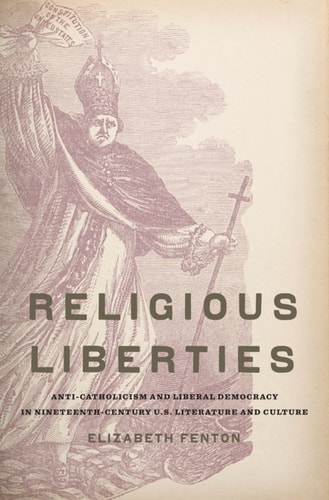
In the late eighteenth and nineteenth centuries, Catholicism was often presented in the U.S. not only as a threat to Protestantism but also as an enemy of democracy. Focusing on literary and cultural representations of Catholics as a political force, Elizabeth Fenton argues that the U.S. perception of religious freedom grew partly, and paradoxically, out of a sometimes virulent but often genteel anti-Catholicism. Depictions of Catholicism's imagined intolerance and cruelty allowed writers time and again to depict their nation as tolerant and free. As Religious Liberties shows, anti-Catholic sentiment particularly shaped U.S. conceptions of pluralism and its relationship to issues as diverse as religious privacy, territorial expansion, female citizenship, political representation, chattel slavery, and governmental partisanship.Drawing on a wide range of materials--from the Federalist Papers to antebellum biographies of Toussaint Louverture; from nativist treatises to Margaret Fuller's journalism; from convent exposés to novels by Catharine Sedgwick, Augusta J. Evans, Nathanial Hawthorne, Harriet Beecher Stowe, Herman Melville, and Mark Twain--Fenton's study excavates the influence of anti-Catholic sentiment on both the liberal tradition and early U.S. culture more generally. In concert, these texts suggest how the prejudice against Catholicism facilitated an alignment of U.S. nationalism with Protestantism, thus ensuring the mutual dependence, rather than the putative "separation" of church and state.
Menrva's Summary
THE THESIS
How did anti-Catholic sentiment function as a foundational mechanism in the construction of American liberal democracy and national identity during the nineteenth century? Elizabeth Fenton, an associate professor of English, examines the paradoxical role of anti-Catholicism in shaping U.S. conceptions of religious freedom and pluralism. By analyzing a diverse array of literary and political texts, she argues that the perceived threat of Catholicism allowed the United States to define itself as a tolerant, democratic nation through the exclusion of a perceived intolerant "other." This study posits that the alignment of U.S. nationalism with Protestant values fundamentally challenged the theoretical separation of church and state.
THE SCOPE MAP
What You Will Find
- Analysis of nineteenth-century literary works by authors including Hawthorne, Stowe, Melville, and Twain.
- Examination of political documents, nativist treatises, and convent exposés.
- Investigation into the intersection of anti-Catholicism with issues of slavery, female citizenship, and territorial expansion.
Scope Limits
- The study focuses primarily on the nineteenth-century U.S. context and does not provide an exhaustive history of global anti-Catholicism.
- The analysis is limited to the influence of these sentiments on U.S. liberal tradition rather than a comprehensive theological critique of Catholicism.
THE AUTHORITY PERSPECTIVE
Scholars in American literary and cultural studies identify this work as a significant contribution to understanding the formation of U.S. national identity. Readers frequently note the academic density of the prose and the breadth of primary source materials utilized to support the author's argument.
Page Count:
180
Publication Date:
2011-01-01
Publisher:
Oxford University Press
ISBN-10:
0190452528
ISBN-13:
9780190452520
History
Religion
English
American Studies
Literary Criticism
English & College Success
Religion and literature
Cultural History
Community Tags
Similar Books