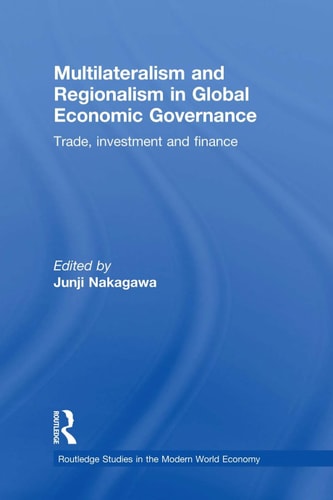
Multilateralism and Regionalism in Global Economic Governance: Trade, Investment and Finance
0
0
As an Amazon Associate and affiliate partner, Menrva Books earns from qualifying purchases. Learn more
Author Description
Reconciling regionalism and multilateralism is a challenge common to all branches of global economic governance. While the Bretton Woods/GATT (WTO) institutions, decades-old multilateral framework for global economic governance, are facing serious challenges to their effectiveness, regional framework are emerging as complementary or alternative means of global economic governance. The real challenge is how to reconcile multilateralism and regionalism in global economic governance. This book tackles this problem by analysing issues of multilateral/regional conciliation and coordination in global economic governance, focusing on Asia. Chapters of the book deal with challenges of multilateralism and regionalism in three fields of global economic governance, namely, global monetary/financial governance, global trade governance, and global investment governance. The major regional focus is on Asia, though some chapters deal with regionalism in Europe and North America. Topics include Asian Monetary Fund and Asian financial architecture, open accession provisions of regional trade agreements, and APEC's role in multilateral investment rules. As a whole, the book elucidates the contemporary reach of Asian regionalism in global economic governance, and shows the neat balance between regionalism and multilateralism in global economic governance. It is of particular use to the students and practitioners of international economic law, international political economy, international finance and international economics, both with and without Asian focus
Menrva's Summary
THE THESIS
This book investigates the complex structural tension between multilateral global economic institutions and the rise of regional frameworks in the modern era. Author Junji Nakagawa, a scholar of international economic law, utilizes a comparative analysis of trade, investment, and monetary governance to argue that regionalism serves as both a potential competitor and a necessary complement to established global systems. By focusing on Asian regional developments, the text provides a framework for understanding how these two governance layers can be reconciled to maintain economic stability.
THE SCOPE MAP
What You Will Find
- Analysis of global monetary and financial governance structures.
- Examination of trade governance and the role of regional trade agreements.
- Investigation into international investment rules and the influence of APEC.
- Comparative case studies focusing on Asian regionalism alongside European and North American models.
THE AUTHORITY PERSPECTIVE
Experts identify this work as a significant contribution to the study of international political economy and international economic law. Readers frequently note the academic density of the prose, making it a valuable resource for practitioners and students seeking to understand the mechanics of global economic coordination.
Page Count:
200
Publication Date:
2011-01-01
Publisher:
Routledge
ISBN-10:
041559569X
ISBN-13:
9780203813942
Economics
International relations
Regionalism
International Trade
Finance
Globalization