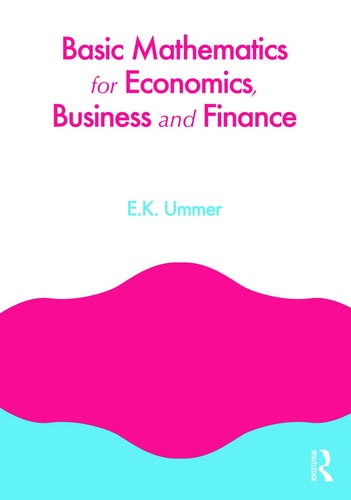
Basic Mathematics for Economics, Business, and Finance
0
0
As an Amazon Associate and affiliate partner, Menrva Books earns from qualifying purchases. Learn more
Author Description
This Book Can Help Overcome The Widely Observed Math-phobia And Math-aversion Among Undergraduate Students In These Subjects. The Book Can Also Help Them Understand Why They Have To Learn Different Mathematical Techniques, How They Can Be Applied, And How They Will Equip The Students In Their Further Studies. The Book Provides A Thorough But Lucid Exposition Of Most Of The Mathematical Techniques Applied In The Fields Of Economics, Business And Finance. The Book Deals With Topics Right From High School Mathematics To Relatively Advanced Areas Of Integral Calculus Covering In The Middle The Topics Of Linear Algebra; Differential Calculus; Classical Optimization; Linear And Nonlinear Programming; And Game Theory. Though The Book Directly Caters To The Needs Of Undergraduate Students In Economics, Business And Finance, Graduate Students In These Subjects Will Also Definitely Find The Book An Invaluable Tool As A Supplementary Reading. The Website Of The Book Ww.emeacollege.ac.in/bmebf Provides Supplementary Materials And Further Readings On Chapters On Difference Equation, Differential Equations, Elements Of Mathematica, And Graphics In Mathematica. It Also Provides Materials On The Applications Of Mathematica, As Well As Teacher And Student Manuals.
Menrva's Summary
THE THESIS
This book investigates the fundamental mathematical techniques required for undergraduate students to succeed in the fields of economics, business, and finance. Author E. K. Ummer addresses the pervasive issue of math-phobia by providing a clear, accessible exposition of essential quantitative methods. The text bridges the gap between high school mathematics and advanced analytical tools, arguing that a strong grasp of these techniques is necessary for both academic progression and practical application in professional settings.
THE SCOPE MAP
What You Will Find
- Comprehensive coverage ranging from foundational high school algebra to advanced integral calculus.
- Detailed modules on linear algebra, differential calculus, and classical optimization techniques.
- Specialized sections on linear and nonlinear programming alongside an introduction to game theory.
- Supplementary digital resources including manuals and software-specific guides for Mathematica.
THE AUTHORITY PERSPECTIVE
Educators and students frequently utilize this text as a bridge between basic arithmetic and the complex quantitative modeling required in higher-level economics. The consensus highlights the book's effectiveness in demystifying abstract concepts for undergraduates while serving as a reliable reference for graduate-level supplementary study.
Page Count:
483
Publication Date:
2011-01-01
Publisher:
Routledge
ISBN-10:
020381732X
ISBN-13:
9780203817322
Economics
Business
Finance
Business Mathematics
Calculus
Mathematica Computer Program
Mathematics
Linear Algebra
textbook