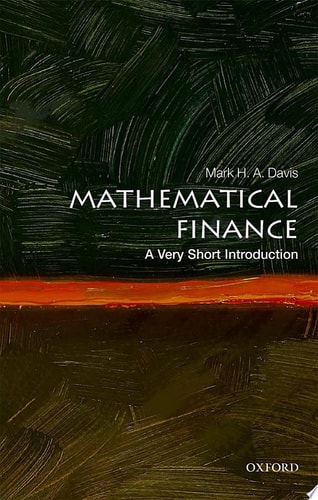
Mathematical Finance: A Very Short Introduction
0
0
As an Amazon Associate and affiliate partner, Menrva Books earns from qualifying purchases. Learn more
Author Description
In recent years the finance industry has mushroomed to become an important part of modern economies, and many science and engineering graduates have joined the industry as quantitative analysts, with mathematical and computational skills that are needed to solve complex problems of asset valuation and risk management. An important parallel story exists of scientific endeavour. Between 1965-1995, insightful ideas in economics about asset valuation were turned into a mathematical 'theory of arbitrage', an enterprise whose first achievement was the famous 1973 Black-Scholes formula, followed by extensive investigations using all the resources of modern analysis and probability. The growth of the finance industry proceeded hand-in-hand with these developments. Now new challenges arise to deal with the fallout from the 2008 financial crisis and to take advantage of new technology, which has revolutionized the practice of trading. This Very Short Introduction introduces readers with no previous background in this area to arbitrage theory and why it works the way it does. Illuminating pricing theory, Mark Davis explains its applications to interest rates, credit trading, fund management and risk management. He concludes with a survey of the most pressing issues in mathematical finance today. ABOUT THE SERIES: The Very Short Introductions series from Oxford University Press contains hundreds of titles in almost every subject area. These pocket-sized books are the perfect way to get ahead in a new subject quickly. Our expert authors combine facts, analysis, perspective, new ideas, and enthusiasm to make interesting and challenging topics highly readable.
Menrva's Summary
THE THESIS
How does the mathematical theory of arbitrage provide a framework for understanding modern asset valuation and financial risk management? Mark H. A. Davis, an expert in the field, examines the evolution of financial mathematics from the mid-20th century to the post-2008 economic landscape. He synthesizes complex economic theories into a coherent narrative, explaining how quantitative analysis became the backbone of modern trading and risk assessment. The text serves as an entry point for readers seeking to understand the mechanics behind asset pricing and the mathematical rigor required in contemporary finance.
THE SCOPE MAP
What You Will Find
- The historical development of arbitrage theory from 1965 to 1995
- An explanation of the Black-Scholes formula and its impact on market valuation
- Applications of pricing theory in interest rates, credit trading, and fund management
- A survey of current challenges in the financial sector following the 2008 crisis
Scope Limits
- The book does not provide a comprehensive manual for professional quantitative trading
- It avoids overly dense technical proofs that would require advanced graduate-level mathematics
THE AUTHORITY PERSPECTIVE
Experts and readers recognize this work as a concise, accessible primer for those entering the quantitative finance industry. The prose is noted for its ability to distill high-level mathematical concepts into a format suitable for non-specialists and students.
Page Count:
160
Publication Date:
2019-01-01
Publisher:
OUP Oxford
ISBN-10:
0191092037
ISBN-13:
9780191092039
Economics
Mathematics
Mathematics - General
Academic
Mathematics Statistics
Business Mathematics
Finance